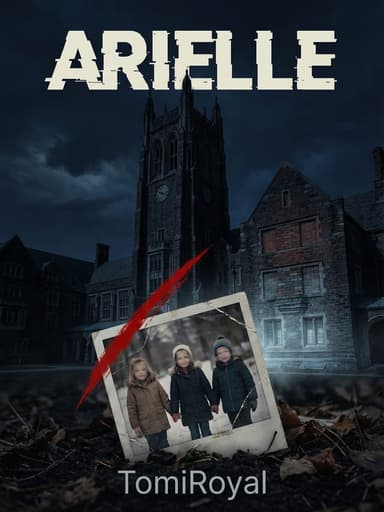
ARIELLE
- 👁 5
- ⭐ 7.5
- 💬 6
Annotation
“I can’t do this.” Is he really doing this right now? “Obviously,” I interrupted with an eye roll, because being sarcastic was the only way I knew to keep what I really wanted to say in. He responded by shaking his head, with a tight set to his jaw. “Not like this,” he continued. “It wouldn’t be fair to you.” There it was again, the barricade and invisible line he always labeled ‘not yet.’ “Fair,” I repeated. “That’s what you’re worried about?” ***** Arielle had always known she was good at observing people. She just never imagined she was one of the experiments. Halebridge University was supposed to be her second chance. She got in as a scholarship student majoring in art, and managed to bag herself a quiet job at the campus café. She had a new life she was building with her own hands, away from her suffocating relationship with her mother back at home. But then the cracks appeared: She finds an old photograph she doesn’t remember, which makes her question everything she thought she knew about her childhood, Then there was the locked tower no one would talk about that gave off eerie vibes, And she encountered twin strangers on campus who looked at her like they’d been waiting years for her to arrive: the handsome but intense graduate student, and the sharp-eyed artist whose gaze felt like both an accusation and a warning. It wasn’t until a threatening message appeared in her inbox that Arielle realized something life-changing. Someone wasn’t just hiding the truth, but they were also willing to destroy her life to keep it buried. Because she was never just Arielle. She was Subject A. In a campus where every locked door hides a history and every kindness might be a strategy, Arielle must decide how much of the truth she’s willing to remember, and what it will cost her and everyone she loves if she does.
PROLOGUE
The day everything went south.
They came for her memories.
Carlos didn’t see the procedure. He had already been banned from any direct contact with the family wing after the first extraction had failed, but he heard enough.
“Phase Three, Profile A,” he heard a clinician say while hiding in a corridor he wasn’t authorized to be close to.
“A new identity has been assigned, parental figures are out of the way, and ties with other subjects have been severed. It might sound over the top, but the board wants a clean case before we pack up everything.”
Clean case. Sick.
When he heard that, he pressed himself deeper against the wall as though wanting to be merged with it, his heart pounding dangerously. But he didn’t dare leave. He continued listening to them discuss her like a lab specimen.
After that, a new file appeared, containing a new name and a new location.
The program hired a social worker for the transfer as a grand effort to be subtle. They had, after all, started gaining attention, and nobody wanted that.
The social worker was a woman with kind eyes who arrived early one morning carrying a clipboard and wearing the badge of a government department Carlos didn’t recognize. That made him suspect her even more.
He watched everything from a narrow stairwell window overlooking the exit loop. It was inconspicuous enough that nobody would think to look for him there.
When he saw her, she looked smaller than she should have, with neatly brushed hair and clothes he hadn’t seen her wear before, walking out between two staff members and the social worker.
Her gaze was unfocused, as if she had just woken up from a very long nap and wasn’t sure of her surroundings. Her steps were measured and careful, like those of a robot.
What made it worse was when she looked briefly at him, and there was no recognition. Not a hint that said she remembered the boy whose hands were pressed flat against the glass, his throat full of unsaid words.
Her expression just remained neutral.
She was led to the back door of a plain sedan, and the social worker guided her in and buckled her seatbelt. The adults then went on to change papers and sign off on the transfer.
They made it look too easy, like they had done the same thing before and would do it again if necessary. The social worker got in the car, and it pulled away.
Carlos just remained standing there, leaning against the glass. It wasn’t until later, when he saw the prints his palm left, that he realized how hard he’d been leaning.
He had always thought somewhere in his mind that if push turned to shove, he would try defending her by doing something dramatic. Like throwing himself in front of the car, for instance.
He thought he would make enough of a scene to throw off the plans.
Instead, he stood there: fourteen, furious and helpless, and watched her go.
Carla found him later, screaming at the guards after the car had long since disappeared.
“They wiped her,” he said, voice too hoarse from screaming. “She looked right past me.”
“I know,” Carla answered. He couldn’t read the expression on her face. She had gotten so good at masking them after him.
He didn’t know why, but he turned on her then, boiling with so much rage. “Remember, we promised,” he hissed. “You promised—”
“I know,” she repeated, louder this time. “I do not need you to nag me, I already hear him in my head every time I breathe.”
They stared at each other, both of them so vulnerable in a way the program would have deemed useful material.
“What do we do now?” Carlos asked, breaking the silence. The words came out rough and bitter.
“What we do now is ensure that wasn’t the last time you ever see her. They erased us from her, not the other way around, so we have the upper hand. It’s their blind spot, and we’re going to use it.”
“How?”
She looked out through the window, as though following the ghost of the car along the distant road.
“By first of all, finding where they put her. We wait for the program to go under, because it’s currently on the verge of it. Afterwards,” she added, her eyes darkening, “we go get her. We do whatever it takes.”
That was years ago.
As suspected, the program did go under, in a way. The facility changed names, and contracts ended before it quietly shut down. The staff got scattered abroad, with important files getting either boxed up, shipped, or ‘misplaced.’
Carlos and Carla switched from facility uniforms to civilian clothes under a condition, while keeping an eye on adoption records, scholarship programs, and every blank backstory that looked suspicious in university applications.
The only thing that didn’t change for Carlos, however, was the moment in that stairwell window.
He kept playing it on repeat in his head. Her walking toward a car with a stranger, and him watching with his fists clenched uselessly at his sides, his breath fogging the glass.
It was the first time he experienced loss, not caused by death, but by orchestration.
And right now, watching her cross the quad with a bag full of paintings and a new name, that memory collided with the present so hard it stole his breath.
She didn’t remember him.
But he remembered everything.
And the only part of the program’s story he still believed in was the promise he made to himself.
The promise that if he couldn’t stop them from taking her, then he would spend whatever was left of his life finding her again.
A promise that took him almost half of his life to fulfill.
Chapter 1
They say your life can fit in a suitcase. Well, who needs a suitcase when it can fit in a duffel bag and some cardboard boxes?
The air that day carried the same scent as the first time I tried to run away from home, pressing against me in an effort to keep me. Dust mixed with my mother’s expensive perfume, the one she bought more as a reminder of who she used to be than for actual use, and settled in the corners of the house like regret.
By the corner of my room stood a mahogany dresser that belonged to some long-dead ancestor. I could see how dusty it was, and that’s because I stopped caring about cleaning a long time ago.
I folded another sweater into my duffel bag with more care than it deserved. It was wool and charcoal grey, expensive enough to be important but cheap enough that I wouldn’t panic if it went missing.
A perfect balance, a pity my life was nowhere near perfect.
I hardly got attached to things; it was a useful skill I picked up by calcu










Use AlphaNovel to read novels online anytime and anywhere
Enter a world where you can read the stories and find the best romantic novel and alpha werewolf romance books worthy of your attention.


 Scan the qr-code, and go to the download app