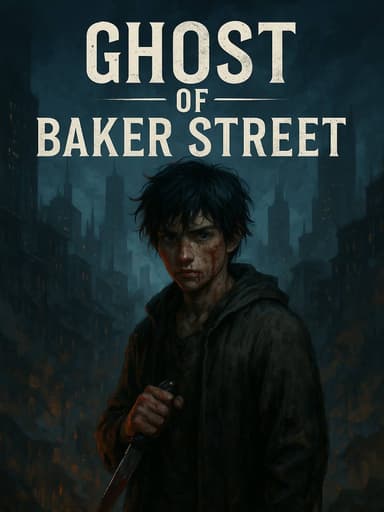
Ashes of the Thirteenth City
- Genre: Paranormal
- Author: Beckey
- Chapters: 38
- Status: Completed
- Age Rating: 18+
- 👁 136
- ⭐ 7.5
- 💬 1
Annotation
In a fractured empire where the powerful rule and the powerless vanish, a mysterious killer stalks the criminal underworld of the Thirteenth City — leaving no trace but a trail of perfect, surgical deaths. Nicknamed "The Ghost of Baker Street," this vigilante targets monsters hiding in plain sight — but the government wants him gone, dead or disappeared. As elite operatives of the Surveillance Bureau dig deeper, what they uncover may shatter everything they believe about space, power… and reality itself.
Chapter 1 The Phantom
Dominion of Anqing, Thirteenth City – Internal Surveillance Bureau, Subdivision B1
The corridor on the lower level of the Surveillance Bureau's substation was dimly lit and eerily silent. A man and a woman walked side by side, their footsteps echoing between steel walls lined with black, soundproofed chambers. From within those rooms came bone-chilling howls — not quite human, not quite beast — the kind that crawled beneath your skin and stayed there.
The man was massive. Clad in an all-black tactical suit, his physique resembled a moving fortress of muscle. A jagged scar ran down the left side of his face, but instead of marring his looks, it only enhanced the lethal charisma he radiated.
The woman beside him wore a form-fitting white combat uniform that hugged every curve of her figure with precision. Her shoulder-length red hair blazed like wildfire, flickering under the hallway’s flickering lights — a flame that danced, defiant and dangerous. She moved with the grace of a predator and the silence of a ghost.
The contrast between them was stark — light and dark, flame and stone — but one thing marked them as kin: the blood-red insignia pinned to their chests.
Without a word, they reached the iron door at the end of the hallway. The man pushed it open, and despite making no sound, those inside immediately stood at attention. A young agent, clearly the most junior in the room, was the first to speak.
“Commander!”
The towering man gave him a small nod, his face a granite mask, then offered a brief glance toward the others in the room. Without a word, he strode to the central command console. His massive frame was silent but tense, like a fuse just waiting for flame.
Then—CRACK.
His fist slammed through the central display. Sparks burst from the shattered glass like a nest of electric vipers. His forearm plunged into the console, tearing through cables and circuits until the screen crackled and died. When he pulled his hand back, the arm was scorched, sparking, and slick with synthetic oil.
No one flinched. No one moved. This was not the first time they’d seen him like this.
The commander turned, face composed, voice calm. But his clenched fist and bulging veins told the truth.
“Director Rhoades dragged me into a meeting today,” he growled. “Guess who was sitting across the table? Blaure — that b*st*rd. I got grilled for two. Whole. Hours. Do you know how long that feels? I’d rather go hand-to-hand with a wasteland beast than see that smug face again.”
Silence. The team avoided his eyes like it might spark another outburst.
He scanned the room. “Progress report. Now.”
A man in glasses cleared his throat and stepped forward.
“No concrete leads yet, sir,” he said. “We’ve profiled multiple cases. The targets are mostly confirmed criminals — some even classified as Blood-Variants. Based on attack patterns and autopsies, we believe the suspect is an Emerged, though the exact nature of his ability remains unknown.”
The commander narrowed his eyes.
“Continue.”
“All fatal wounds are identical — precise, clean strikes to the neck or heart. Instant death. No hesitation. No second attempts. He’s efficient. Clinical. More than that — he’s a ghost. We’ve found nothing at the crime scenes. No footprints. No residual energy. No psychic trails. Just... nothing.”
“A ghost?” the commander muttered, voice low with curiosity. “Interesting. Not even your ability can give us a lead?”
The man with glasses adjusted his frames, slightly embarrassed.
“It’s not that my profiling doesn’t work,” he explained. “It’s that... there’s nothing for me to connect to. No emotional imprint. No psychic residue. No objects left behind. Nothing.”
The commander’s brow furrowed.
“It’s like the entire scene was—disconnected,” the profiler continued. “As if reality itself was altered. Like the environment he was supposed to be in had been... erased. Or maybe, it was never there to begin with.”
The room went quiet again. The explanation was more unsettling than any violent detail.
No one really understood what he meant, but everyone felt it: that hollow, unnatural absence — like staring at a painting and realizing the canvas was empty all along.
The glasses man smirked slightly to himself. That reaction — the unease, the confusion — was exactly what he wanted. After all, what was the point of being a specialist if no one could understand your specialty?
He raised two fingers, almost like he was lecturing.
“There are two possible explanations,” he began. “First — the victims were walking along normally, and suddenly... they just died. No attacker seen. No action taken. Just instant death, as if the fatal wounds appeared out of thin air.”
“Ridiculous,” the commander scoffed. “What’s the second?”
The man’s eyes gleamed with excitement, as if he were about to reveal a great cosmic truth.
“Second possibility: the killer can bend space. Tear it, twist it, maybe even slice through it.”
The room fell into stunned silence.
Everyone in the room — seasoned agents, war survivors, Emerged monitors — all went still. No one wanted to accept what they’d just heard. Not because it didn’t make sense — but because it did.
“Space manipulation?” someone muttered, almost to themselves. “That’s... absurd.”
“No more absurd than someone dying without a trace,” Raf replied, lips curled into a half-smile. “You tell me which version is easier to swallow.”
Still, no one responded. Not even the commander.
Finally, someone else spoke up from the side.
“What about... a curse? Maybe it's not a spatial anomaly, but a supernatural affliction.”
Raf raised an eyebrow, visibly unimpressed.
“A curse that leaves clean, physical lacerations across the heart and neck?” he said. “You’re telling me some hex kills people with surgical precision?”
The agent shrugged. “Could it be a setup? A frame job? Maybe someone wants us to think it’s one guy.”
The commander rolled his eyes and rubbed his temples, clearly running out of patience.
“Frame job? Who the hell has the time or reason to mimic this? You think a curse-user needs to ‘frame’ someone for killing a few parasites in the slums?”
The agent fell silent, finally understanding the ridiculousness of his own theory.
The commander was silent for a long moment.
Everyone waited. The room was tense, still, as if the air itself was holding its breath.
“Raf,” the commander finally said, his voice low but firm. “You do realize... no one has ever awakened powers over space. Not truly. The only ‘space-related’ tech we have comes from alchemists using refined dimensional stones. And even then, it’s limited to lifeless storage objects. Not active manipulation.”
He leaned in slightly.
“No one... not even the Emerged... controls space.”
Raf met his gaze, expression unreadable, but said nothing.
The commander straightened, eyes scanning the room again.
“This theory of yours? It never happened. You understand?”
Raf nodded once, the flicker of enthusiasm now gone from his face.
“Good. Then we’re done here.”
He turned to the rest of the team.
“Find a scapegoat. Wrap the case. And until this so-called ‘Ghost of Justice’ starts killing civilians, every similar case gets buried. Understood?”
The room responded in unison, fists striking over hearts with trained precision.
“Yes, sir!”
Chapter 2 Secrets
The boy rested briefly, but the dizziness returned—sharp and disorienting, the result of an empty stomach and low blood sugar. He stood and began cleaning the "wild rabbit" he had caught. The blood was poured carefully into a bamboo bowl, the meat was portioned into several cuts, and the pelt—remarkably intact—was peeled off in one clean sweep.
In Baker Street, nothing held more value than animal pelts. It didn’t matter what kind of beast it came from—the corner general store would pay good coin for any fur. Winter was drawing near, and here in Baker Street, winter was the season of death. Those without money for thick coats rarely lived to see the spring.
After tidying up the room—which had looked moments ago like the site of a violent crime—the boy reached beneath the stone table into a small hollow and pulled out a slab of jerky. Smoked until dry and hardened to the point of being stone-like, it was nearly inedible without serious effort. On Baker Street, such meat wa











Use AlphaNovel to read novels online anytime and anywhere
Enter a world where you can read the stories and find the best romantic novel and alpha werewolf romance books worthy of your attention.


 Scan the qr-code, and go to the download app