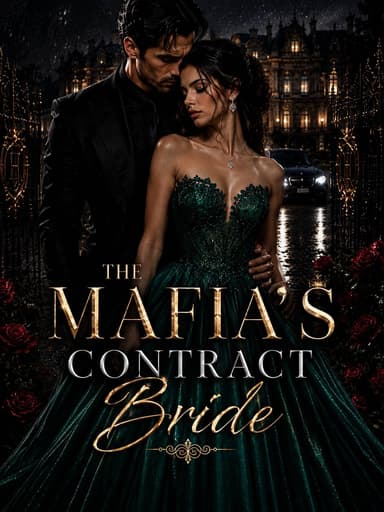
The Mafia's Contract Bride
- Genere: Romance
- Autore: Serena Crystal
- Capitoli: 20
- Stato: Completato
- Classificazione per età: 18+
- 👁 614
- ⭐ 7.5
- 💬 7
Sinossi
There is no price for which a good man sells his daughter."The night Aria Bennett's father knocks on her door at eleven o'clock, she doesn't know she's being sold. She only knows that something is wrong – the rain, the late hour, the stranger waiting in the study downstairs.Dominic Hargrove is not a businessman. He is a kingpin. A killer. A man who has spent fifteen years building walls around a heart shattered by his first wife's mysterious death. When RaymondBennett comes to him with a debt he cannot pay, Dominic sees an opportunity – not just for expansion, but for something he has denied himself for years.A wife he doesn't have to love. A marriage he doesn't have to feel.The contract is simple: two years. A credible performance. No feelings.But Aria Bennett is not a woman who performs. She is a woman who survived her mother's slow, suspicious death. She is a woman who reads books and writesin notebooks and refuses to be impressed by things that impress everyone else. And when she looks at Dominic Hargrov – really looks – she sees past the locked doors and the dark suits to the man beneath.The man who is watching her. The man who chose her. The man who will burn the world down to keep her.As Nicolai – a rival kingpin with a fifteen-year grudge – closes in, as secrets about Aria's mother begin to surface, as the line between performance and reality dissolves, they will both learn the truth:Some contracts are made to be broken. Some loves are worth dying for.And in a world of locked doors and bloodied hands, the most dangerous thing of all is not the enemy at the gate – but the wife who refuses to be owned.
Chapter 1
"There is no price for which a good man sells his daughter."— ProverbThe night my father sold me, it was raining.
I remember thinking that was fitting — the kind of detail that would appear in one of the novels stacked on my stacked on my nightstand, the kind writers call pathetic fallacy, where the sky mirrors the grief the characters haven't yet understood they feel.As if the weather knew what was happening in the study down the hall before I did.I'd been in bed since nine, which wasn't unusual. It was a Wednesday in October, I had finished my last shift at the bookshop, and I was rereading an old favorite — the kind of book that asks nothing of you, that opens like a door into a room where everything is already understood .I'd been doing a lot of rereading lately. Original things required a kind of emotional availability I hadn't had much of since my mother died two years ago and the house started feeling like a held breath.When my father knocked, I knew from the sound of it. Not the content of what was coming — I couldn't have guessed that — but the specific texture of a knock that carries bad news. He was a man of habits and patterns, and this was not his pattern. Eleven o'clock. A knock instead of a shout up the stairs. The faint formality of it, like he'd practiced on the other side of the door.
"Aria." His voice through the wood. "Come down to the study. There's someone I want you to meet."Someone I want you to meet.I set my book face-down on the duvet and sat there for a moment, listening to the rain against the window, and felt the first small pulse of something that wasn't quite dread, but was adjacent to it.
Then I put on my slippers and went downstairs.My father's study had always smelled of old paper and failed ambition. He'd lined the walls with books he never read, displayed there the way furniture is displayed — for the impression of a certain kind of person, rather than for use. The desk was mahogany and enormous. The chair behind it made him look smaller than he was.
He was behind it now. Standing, not sitting, which was unusual — as if even he understood that sitting would have felt too comfortable, too casual, for whatever this was.And across the room, near the window, stood a man I had never seen before.My first impression was stillness. He wasn't doing anything — wasn't fidgeting or examining the bookshelves or checking his phone the way people do when they're waiting in an unfamiliar room. He was simply standing, hands in the pockets of a dark suit, watching the rain against the glass. When I came in, he turned and looked at me, and I had the immediate, disorienting sensation of being assessed.Not in the way men sometimes assess women in rooms. Not appraisingly. More the way a very intelligent person takes in information — efficiently, completely, missing nothing.He was tall. Dark-haired. A face made up entirely of clean, deliberate lines, as if someone had decided that handsome was less important than precise. He might have been anywhere between thirty and forty. His suit cost more than my monthly rent.I didn't know who he was yet. But I knew, in the particular animal way that the body knows things before the mind catches up, that he was the reason for the knock at eleven o'clock."Aria." My father's voice had a quality I recognized: the careful steadiness of a man performing composure. "This is Mr. Hargrove. Dominic Hargrove."I knew the name. Everyone in this city knew the name — it was engraved on half the buildings downtown, printed in the business section with the reliable frequency of weather reports. Hargrove Industries. Hotels, infrastructure, real estate, and a dozen other things besides. A name that functioned less like a name and more like an institution.I looked at my father. Then at Dominic Hargrove. Then back at my father.
"It's eleven o'clock," I said.
"I know." My father had the grace to look briefly uncomfortable. "Please sit down."I sat in the chair across from the desk — the one that had always made me feel like I was being called in for a disciplinary meeting, even in my own home — and folded my hands in my lap and waited.Something had already been decided; I could feel the shape of it in the room, the way you feel a storm before it arrives. I had been called down to be informed, not consulted.Understanding this did not make me feel better. It did, however, make me feel clear.contracts, the restructuring, the debt. I had known in the peripheral way that children of anxious men always know things: that the company was struggling, that he'd been making calls at odd hours, that there were papers he'd hurried to turn face-down when I walked past. I'd chosen not to examine it too closely, because examining things closely was how you became responsible for them.I was regretting that now."The short of it," my father said at last — and then stopped, as if even now he was searching for a version of the truth that would be easier to deliver — "is that Mr.Hargrove has made an offer. Regarding Bennett Construction. He's prepared to absorb the company's debt and restructure, rather than pursue the acquisition through the courts, which would mean—""Liquidation," Dominic Hargrove said. His voice was low, unhurried, with the quiet authority of a man who had never once needed to raise it to be heard. He said it the way you'd state the weather. "The litigation would take eighteen months and your father would lose. Everything. The company, the assets, this house."looked at Dominic Hargrove directly for the first time since I'd entered the room. He was looking back at me with that same careful, measuring quality — not cruel, not warm. Simply attentive.
"And the condition of the offer," I said. Not a question."A contract marriage," he said. "Between the two of us. Two years in duration. You would reside in my home, attend social and professional functions as my wife, and maintain the credible appearance of a genuine partnership.In exchange, Bennett Construction is restructured under Hargrove Industries as a subsidiary. The personal debts are cleared. The forty-three employees keep their positions."The room was very quiet. Even the rain seemed to have paused.
I turned to my father. "You agreed to this."
He looked at the desk. "I thought—"
"You agreed to this," I said again. Not loudly.There was no need to be loud. "Before you spoke to me. Before you asked me."
"Aria—"
"I'm establishing facts," I said. "Not accusing you. Not yet."
I stood up. Walked to the window, not the one where Dominic Hargrove had been standing — the other one, the one that looked out over the garden where my mother used to grow things. The glass was cold when I pressed my fingertips to it. Outside, the rain had started again, or perhaps it had never stopped.I thought about my mother. About what she would say if she were standing in this room right now. I thought I knew, and the knowing of it made something in my chest pull tight and then release — like a knot being cut rather than untied.Then I turned around."I have questions," I said to Dominic Hargrove.
He inclined his head. Not permission, exactly. More the acknowledgment that questions were a reasonable thing to have "Why a marriage? Why not a contract employee, a paid companion, whatever you need me to appear to be?"
"My board has been pressing for stability. A CEO without personal ties is a liability in certain sectors — a marriage, a settled life, reads as permanence. An employee can leave. A wife is a commitment." Something crossed his face. "Or appears to be.""Two years is not very permanent."
"Two years is enough for what I need. By then, the restructuring will be complete and the optics will be irrelevant."
"And you couldn't find someone willing?" I asked. "Someone you actually chose?"A pause — brief, but present. "This arrangement was efficient."I filed that word away."If I agree," I said, "I have conditions."My father made a sound from behind the desk. I ignored him.Dominic Hargrove looked at me steadily. "State them."
"I keep my autonomy. My time, outside of whatever functions you require me to attend, is my own. I am not a prop. I am not decorative."I keep my autonomy. My time, outside of whatever functions you require me to attend, is my own. I am not a prop. I am not decorative. I will not be managed or spoken over or made to feel that my presence in your home is a concession.""Agreed.""The arrangement ends in two years. No extensions, no renegotiation, no pressure to continue under any guise.""Agreed.""And I want it in writing. Not your word. Paper, signatures, lawyers.""That was already the plan," he said.I looked at him for a long moment. He looked back. There was something in his expression that I couldn't entirely read — not quite surprise, not quite respect. Something between the two, suspended there, waiting."One more thing," I said."Go ahead.""My father never speaks of this as something he did for me.Not to me, not to anyone else.If I find out he's been telling people he made this sacrifice for my benefit, the agreement is void."The silence that followed was the most interesting thing that had happened all evening, because Dominic Hargrove almost — almost — smiled."I'll have the contract drafted by Thursday," he said.He left at half past eleven.I walked him to the door because my father seemed incapable of movement, and because it seemed like the kind of thing that should be done — a small, absurd formality in the middle of an absurd evening.At the door, he paused, and I thought he was going to say something significant, something that would reframe what had just happened into something bearable or comprehensible.Instead: "Bring books, if you want. There's room."Then he stepped out into the rain and into the waiting car and was gone.I stood at the door for a moment, the cold air coming in, and thought: he noticed the book. When I came downstairs. He noticed I'd been reading.It was such a small thing. I didn't know what to do with it.I did not speak to my father that night.He followed me into the hallway and said my name, and I turned and looked at him — really looked at him, this man who had raised me and buried my mother beside me and then, in one private meeting I hadn't been invited to, decided what I was worth and what I could be traded for — and I found that I had nothing to say that would be fair, or useful, or anything other than a wound.So I said nothing. I went upstairs.I lay in my childhood bed and stared at the ceiling.and listened to the rain, and I thought about the next two years. I thought about what I was giving up, which was not as much as it should have been — a rented room, a bookshop job, a life that had been quietly shrinking since my mother died and I'd stopped being able to imagine a future that felt like mine.I thought about what I was preserving: forty-three strangers who would keep their jobs. A company that deserved better than its owner. A debt that wasn't mine to pay, cancelled anyway.I thought about a man who noticed books. Who said efficient instead of convenient or necessary or any of the softer words my father would have chosen.I thought: this is happening. This is real and it is happening and I did not choose it but I am in it now, and the only question is what kind of person I intend to be inside it.My mother had a saying. She'd borrowed it from somewhere — a book, probably, she was a great borrower of other people's wisdom — and she'd said it to me in the hospital near the end, her hand in mine, her voice already thinning: You don't get to choose the weather, my love. Only what you wear into it.I reached over and picked up my book from the nightstand.
I found my page.I read until the rain stopped and the room went grey with early morning, and by the time I finally slept, I had made a decision: I was going to walk into this with my eyes open. I was not going to be diminished by it. I was not going to disappear.I had survived Raymond Bennett for twenty-two years.
I could survive two years of Dominic Hargrove.
I told myself this like I could survive two years of Dominic Hargrove.I told myself this like a prayer. Like a promise.
Chapter 2
The document arrived on Thursday, as promised.It was delivered by hand at eight in the morning, in a leather folio that probably cost more than my weekly grocery budget, and I read it three times before I finished my coffee. Not because it was complicated — it was, deliberately, almost aggressively clear — but because I wanted to understand precisely what I was signing.Marriage Agreement. Term: twenty-four months. Dissolution: automatic upon conclusion, no fault, no contest, no claims to assets or spousal support.
Compensation:
I stopped there, because there was a number, and the number was obscene.Not obscene in the moral sense, though I supposed someone could make that argument. Obscene in the visceral sense — the kind of number that didn't belong in the same room as a rented room and a bookshop job and the careful arithmetic I'd been doing since my mother's medical bills stopped coming.It would clear my father's debt, the contract explained, and also provide a separat
Ti piacerà anche











Usa AlphaNovel per leggere romanzi online quando vuoi e dove vuoi
Entra in un mondo dove potrai leggere tante storie e trovare i migliori romanzi d’amore e libri romantici con lupi mannari alfa che meritano la tua attenzione.


 Scansiona il codice QR e vai al download dell'app