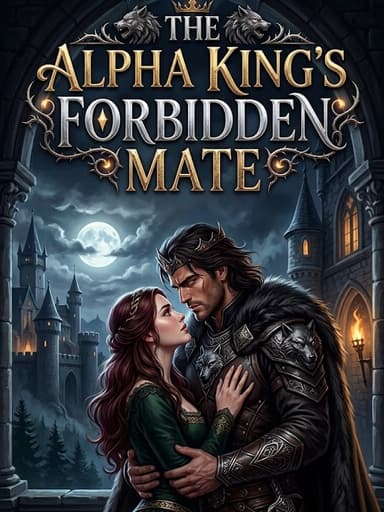
The Alpha King’s Forbidden Mate
- Gênero: Werewolf
- Autor: Hayden Cross
- Capítulos: 10
- Status: Em andamento
- Classificação etária: 18+
- 👁 7
- ⭐ 5.0
- 💬 0
Sinopse
They call me the Cutter. For nine years I've severed mate bonds for women the Goddess got wrong — the beaten, the sold, the ones no Alpha would ever release. I take their bond into my own body and I carry it. That's the price. My chest is a graveyard of other people's love. I have eleven scars. I'll live through maybe three more. Then Stellan Vayne, Alpha King of the Ninefold, drags me out of a burning safehouse — not to execute me, but to *hire* me. The Goddess has bonded him to a stranger, and in six weeks he marries a rival Alpha's daughter or the north goes to war. He wants the bond found. Cut. Buried. He puts a fortune in my hands and asks if I can do it. I say yes. I say yes while his scent is crawling under my skin. While the mark burns awake at the base of my spine. While I understand, with a clarity that feels like drowning, exactly whose bond he's paying me to kill. Mine. And here's the thing no one outside the trade knows: **a Cutter can't sever her own bond.** Nobody can. Every day I stall, the tether thickens. Past sixty days it can't be broken at all — only survived, or died from. So I'll lie to him. I'll hunt myself across his kingdom. I'll stand in his war room and swear I'm close. Because the moment Stellan Vayne finds out what I am, he has two choices: burn me like the law demands, or take me as his Luna and lose his crown, his treaty, and forty thousand lives. I've spent my life proving the Goddess makes mistakes. He's going to make me prove it one last time — on me.
Chapter One: Somebody Has To
DAY 1
The woman on the table had been Bonded for eleven years, and for nine of them her mate had been breaking her.
"I need you to hold still," I said.
"I am still."
"Your hands aren't."
She looked down at them like they belonged to someone else. Both were shaking against the boards, and the left one was set wrong at the wrist — badly, the way a bone knits when nobody's paid to set it. She curled the fingers in. Uncurled them. Curled them again.
"Sorry," she said.
Nobody who comes to me should ever have to apologise to me, and they all do. Every single one.
The room was a garret above Fenn's tannery in the Warren, and it smelled like it. Lime and hide and the sweetish rot underneath that never scrubs out. A tallow lamp on the sill. A bucket of clean water. A table that was really a door laid over two barrels, and on the door, Mira Solt, thirty-four years old, who had walked eleven miles through mud to get to a room that stank of dead animals because it was the only room in the Ninefold where a woman could ask for what she was asking for.
"Tell me his name," I said.
"Do you need it?"
"I need you to say it."
She swallowed. "Garret Solt. Alpha of the Kell Reach."
"And what is he to you?"
"My mate." Her mouth twisted around the word. "The Goddess gave him to me. That's what the Binder said. Sixteen years old, and they put me in white, and the Binder read the silver, and he said — he said the Goddess herself had chosen. That I should be grateful."
"Are you?"
"I want him out of me," she said, and her voice cracked clean down the middle. "I can feel him right now. Do you understand that? He's forty miles away and I can feel him being pleased about something. I don't know what. I've never known what. Eleven years of another person's feelings and I don't get to know why, I just have to carry them, and when he's angry I'm angry and I can't even tell which of us started it anymore—"
"I understand."
"You don't."
I pulled my collar open. Not far. Enough.
The lamp caught them the way it always does: eleven thin silver lines fanned across my sternum, pale as frost on a window, radiating out from the hollow at the base of my throat. They don't look like scars. Scars are ugly and honest. These look decorative, which is the joke.
Mira stopped breathing.
"Eleven," I said, and closed my collar. "Every one of them is somebody's. I've got a woman in here who still loves a man that drowned four years ago. I've got another one who can't hear a door close without going cold all the way through. I didn't choose any of it and I can't put any of it down." I picked up the water and set it beside her head. "So don't tell me I don't understand. Tell me you're sure."
She looked at the ceiling for a long moment. Somewhere below us Fenn was moving hides, the wet slap of them, the scrape of the beam.
"I'm sure," she said.
"Then say the whole thing. All of it, out loud, in this room. It has to be yours."
"I want the bond cut."
"Louder than that."
"I want the bond cut," Mira Solt said, "and I want you to take it."
I put my hand flat on her chest.
Here is the part nobody writes down, because the Bindery burns anyone who writes it down: a bond is not a gift and it is not a blessing and it is not, whatever the silver says, unbreakable. It's a thread. It's got two ends and a middle and it can be found with your fingers the same way you find a splinter under the skin — by feel, by wrongness, by the thing that shouldn't be there.
I found it. Low and to the left, thrumming, thick as twine from eleven years of use.
And then I did the only thing that can be done with it, which is not cutting at all, whatever they call me. You can't destroy a bond. The Goddess doesn't allow it, or physics doesn't, or the two are the same thing. All you can do is move it.
I moved it into me.
It came the way they always come — not a snap but a long slow pull, like drawing a wire out through the middle of your own chest, hot the whole length of it. My knees went. I kept my hand where it was. Somewhere very far away Mira made a sound I've heard a hundred times and will never get used to, the sound of a person hearing silence in a room that's been loud for eleven years.
Then it seated.
And Garret Solt's wife, who was no longer his wife, was inside me, and she was screaming, and she was also — Goddess help us both — she was also in love with him. Underneath. Down at the bottom where the sixteen-year-old in the white dress was still standing. Because that's the truth they don't tell you either. It's never clean. You don't get to take the fear and leave the rest. You take all of it or none.
Twelve now.
I counted it while the room came back. Twelve, and the ceiling is fourteen, and Mab hit fourteen nine years ago and now she lives above a bookbinder's and speaks in other people's memories and doesn't know my name three days out of four.
Two left. Two, and then I'm done.
"It's gone," Mira whispered. She had both hands on her own chest, the broken wrist and the whole one, pressing like she was checking for a heartbeat. "It's — there's nothing there. There's nothing there."
"There's you there."
She started to cry. I let her. I sat down on the floor with my back against the barrel and waited for my hands to stop and thought about nothing at all, which is a skill, and one I'm good at.
"What do I do now?" she said.
"You go to the coast. Tonight, not tomorrow. There's a woman in Dunmere runs a boarding house, name of Aldis — you say Neve sent you and she'll ask you no questions at all. He'll feel the bond go. He'll feel it go tonight, and he'll be on the road within the hour, and the first place he'll look is your sister's."
"He'll come after me."
"He'll come after the bond," I said. "And the bond's in Vurst now, in my chest, and if he's got any sense of it at all he'll come here." I stood up. "Which is rather the point."
She stared at me.
"Go," I said. "Down the back stair. Fenn's got a cart."
She went. At the door she stopped and turned around and said, "Why do you do this?"
They all ask that too.
"Because somebody has to," I said, which is not the answer, but it's shorter.
I gave her ten minutes. I spent them putting the room back into a room — the door off the barrels, the bucket emptied out the window, the lamp wick trimmed down. You learn to leave nothing. Nine years of leaving nothing.
At eleven minutes I smelled smoke.
Not tannery smoke. Tannery smoke is wet and foul and constant. This was clean and fast and coming up through the floorboards, and under it, threaded through it, something I hadn't smelled in the Warren in my entire life.
Crown wolves. Half a dozen of them at least, and the specific iron-and-cold-stone scent of Hollowmere on every one.
I went to the window. The lane below was full of them. Grey coats, the ninefold knot at the collar, and they weren't even hurrying, which told me everything. They'd fired the ground floor and they'd put men on both ends of the lane and they were waiting with the patience of people who have done this before and know exactly how long it takes.
Someone had sold me. Nine years, and someone had finally sold me.
I want to be able to say I did something clever. There's a loose board over the eaves and a drop to the dyeworks roof and I've rehearsed it in my head a thousand times. I got three steps toward it before the garret door came off its hinges and the room filled up with smoke and grey wool and someone very large took hold of my arm.
"Neve Calloway," he said. "By order of the Crown."
"You've got the wrong garret."
"Open your collar."
I didn't.
He did it for me, two fingers, almost gentle, and the lamp caught the silver, and I watched a man who had probably killed people go absolutely white.
"Twelve," he said.
"Eleven," I said. "You want to try counting again, you can do it at the pyre."
They took me down the back stair while the front of the building went up. I remember that the heat came through the wall like a hand. I remember Fenn standing in the lane with his hides in his arms, not looking at me, and I didn't blame him and I still don't. I remember thinking, with a kind of flat professional calm, that I'd always assumed it would be a mob and not the Crown. That's the trade. You take enough bonds off enough Alphas, one of them turns out to have a cousin in the guard, and then you burn.
There's a square behind the Bindery where they do it. I've watched it done twice, because you should watch, if you're going to be the reason it happens. I know how long it takes.
They marched me out of the lane and I turned toward the square without being told, because there's a dignity in walking to the thing.
The big one caught my shoulder and turned me the other way.
There was a carriage at the mouth of the lane. Black, unmarked, four horses, and the ninefold knot worked into the door in silver thread so fine you'd only see it if you knew to look.
"That's not the way to the square," I said.
"No."
"Then where—"
"Get in."
I got in. It's astonishing what you'll do when someone holds a door.
The inside smelled of leather and cold stone. The door shut. The bolt went across from the outside, and the carriage moved, and through the window I watched the tannery come down in a shower of sparks that went up into the fog like something being sent somewhere.
We did not go to the square.
We went up. Out of the Warren, across Marrowbridge, up the long grey rise where the streets get wide and the lamps get spaced like teeth, and I sat in the dark with twelve women in my chest and worked very hard at not understanding what I was already understanding.
They didn't burn me because they didn't want me dead.
They wanted me for something.
The carriage stopped. The bolt went back. And I stepped out under the black arch of Hollowmere, into a courtyard with forty men in it, every one of them looking at the ground, and at the top of the steps stood a man in a coat the colour of a storm coming in, with a scar through one eyebrow and a face like a door closed on a room you'll never see.
Stellan Vayne. Alpha King of the Ninefold.
"You're the Cutter," he said.
I have been asked that question exactly once before, by a man with a knife, and I lied.
"I am," I said.
Something moved behind his eyes. Relief, maybe. Whatever it was, it frightened me more than the fire had.
"Good," said the King. "Then I have work for you."
Chapter 2: The Room Without a Poker
There is a particular kind of quiet that only exists in rich houses.
The Warren is never quiet. Somebody's always shouting, somebody's dog is always going, the dyeworks run their pumps all night and the whole district hums like a tooth. I grew up inside that noise and I've never once slept without it.
Hollowmere was so quiet I could hear my own blood.
They took me through the courtyard and up a stair and down a corridor that went on longer than any corridor has business going, and the whole way there was nothing — no voices, no doors, no footsteps but ours on stone the colour of old ice. Forty men in the courtyard and not one of them had made a sound. That's not discipline. Discipline has a texture to it, men breathing, men shifting their weight. That was fear, and it was coming down from the top of the steps, and it had been coming down for a while.
The big one walked behind me. Somewhere around the third turn he said, without any particular inflection, "Adr
Você também vai gostar











Use o AlphaNovel para ler romances online a qualquer hora e em qualquer lugar
Entre num mundo onde você pode ler as histórias e encontrar os melhores romances e livros de romance com lobisomens alfa que merecem a sua atenção.


 Escaneie o código QR e acesse o download do aplicativo