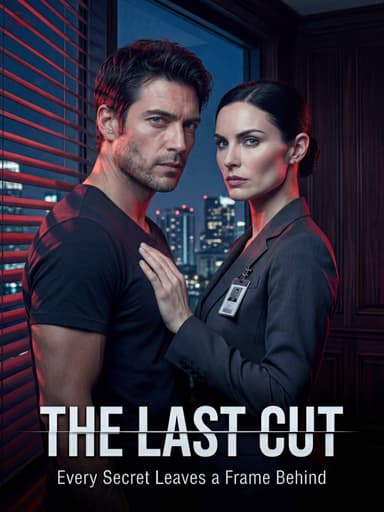
THE LAST CUT
- Genre: Romance
- Author: Abigail Ash
- Chapters: 65
- Status: Completed
- Age Rating: 18+
- 👁 10
- ⭐ 7.5
- 💬 0
Annotation
Cade Morrison edits other people's stories for a living. Finding the frame where the performance breaks. Making the cut before anyone notices. Invisible work. Honest work. At 2 a.m., his mentor calls. From a detention center. Charged with murder. He asks Cade to take a drive from his office before anyone else does. The drive contains eleven files. A screenplay about a woman who found something she wasn't supposed to find. And a chain of evidence leading to someone powerful enough to make problems disappear before anyone thinks to look. Then Sara Lane walks in. Homicide detective. Precise. Controlled. The kind of beautiful that doesn't ask for attention but gets it anyway. She tells Cade he's not a suspect. Yet. She's not telling him everything either. Between them — a case that could destroy them both. And something that starts as distrust and becomes much harder to ignore. "Good editing is what the audience doesn't notice. Good murder is the same thing." Miami. A buried truth. Two people finding each other inside the worst thing they've ever been part of. Explicit content. Tension that builds from the first page. A mystery that runs deeper than the official record. The cut was always there. Someone finally made it.
Chapter 1 - Frame 2,847
The cut was wrong and I'd known it for forty minutes.
Frame 2,847. The actor's eyes move left before the line lands — half a second, maybe less — and the whole scene collapses into the lie it always was. I'd watched it eleven times. I'd watch it again. This is the job: finding the moment where the performance stops believing in itself and cutting before the audience notices.
Good editing is what the audience doesn't notice. Delaney told me that the first week. He was talking about film. I was twenty-three and thought he was talking about everything.
The studio was a converted storage unit in Wynwood, third floor, no windows. Someone had hung blackout curtains over the place where windows would have been if the building had been designed for people instead of inventory. It didn't matter. In post-production you learned to stop needing daylight. You learned to measure time in sequences, not hours. I'd been here since — I checked the corner of the screen — 7 p.m. It was now 2:14 a.m. Somewhere in that gap I'd eaten half a protein bar and decided it counted as dinner.
The studio smelled like cold coffee and the particular desperation of someone else's deadline. Mine too, now. Three weeks to picture lock on a feature that had gone forty days over schedule because the director, a twenty-eight-year-old with one festival hit and the confidence of someone who'd won an Oscar, kept changing his mind about the ending. He'd given me four different versions of the final scene. I'd cut all four. None of them worked. The problem wasn't the edit.
The problem was never the edit.
The AC unit above the door had been humming the same note since midnight — a low, tuneless frequency that matched the generator running somewhere on the street outside. Both of them locked into the same note, neither one able to stop. Miami at 2 a.m. sounds like that. Like something that forgot how to turn itself off. I'd lived here three years and still hadn't adjusted to the way the city ran hot even in the dark, the air outside sitting heavy and salt-thick against the windows of every car, every bar, every room where someone was still awake trying to finish something.
I moved the cut point three frames earlier. Watched it again.
Better. Not right. Better.
I was reaching for the coffee — cold, had been cold for an hour, I was going to drink it anyway — when the phone lit up on the desk beside the keyboard.
Frank Delaney.
I looked at it for one full ring.
Frank Delaney didn't call. This was a known fact, the kind you stopped noticing because it had always been true. Frank Delaney emailed in complete sentences with proper punctuation, like a man who understood that written words outlasted the people who wrote them. He used semicolons correctly. In four years of working together — first as his intern, then his assistant editor, then his editor on two features — he had called me twice. Once when his mother died and he needed someone to tell who wasn't family. Once at 4 a.m. when his first-choice second unit director had been in an accident on the 95 and he needed a replacement before sunrise.
Both times, he'd started talking before I finished saying hello.
I picked up.
"Cade." His voice was the same as always — slow, considered, each word given its final pass before release. But there was something underneath it. A compression I recognized from audio work: the sound of dynamic range pulled too tight, trying to hide the noise in the signal.
"Frank."
"I need you to call David Reiss in the morning. His number is in the production folder — the Halcyon file. Tell him I said to bill the retainer to the holding account."
I knew David Reiss. I'd processed his initial retainer as a line item on the Halcyon budget eight months ago and flagged it as unusual. Criminal defense. Not the kind of attorney a production company kept on retainer for standard industry reasons.
"Frank—"
"The drive on my desk." He didn't stop. "The small one. Black. You know the one."
I knew the one. I'd been in Frank's office more times than I could count and the drive had always been there — next to his Sundance jury citation, in the same corner of the desk, except it was never in exactly the same position twice. A thing that got moved. A thing that got thought about and returned.
"Yes," I said.
"I need you to take it before anyone else does." A pause that had weight to it. A pause that had been decided in advance. "Can you do that?"
The AC hummed. The generator hummed back.
Outside, somewhere on the street, a car alarm went off and then stopped — that abrupt Miami silence after noise, the city swallowing sound the way it swallowed everything else.
"Where are you?" I asked.
He told me.
I wrote it down on the back of the protein bar wrapper because it was the closest piece of paper. The habit was automatic — when someone tells you something that changes the shape of the night, you put it somewhere outside your own head. You don't trust yourself to hold it.
Miami-Dade Pre-Trial Detention Center. Booking.
I looked at what I'd written. I counted the words. Seven. I counted them again.
"Frank." I kept my voice even. "What did you do?"
A pause. The longest one yet.
"Get the drive, Cade." Quieter now — not softer, just quieter, the way a director speaks to an operator when the talent isn't supposed to hear. Like there were other people nearby, or like he'd decided the phone line itself shouldn't catch all of it. "The second act is where people lie. Remember that."
The call ended.
I sat with the phone in my hand and the AC humming its single note and the cursor blinking on frame 2,847 on the monitor in front of me. The actor's eyes still drifted left. The scene still collapsed in the same place. Eleven times I'd run it back. I'd been certain the problem was in the performance — in the body of the actor, in the choice he'd made that morning on set, in the forty-seven minutes between his first take and his last.
I looked at the cut I'd made three frames earlier.
Better. Not right.
I thought about Frank's office. The drive that was never in the same position twice. The way he'd said before anyone else does like there was already a list of people, already a sequence of events moving without me, already a second act underway in a film I hadn't known I was in.
Frank Delaney had directed eleven features in thirty years. He knew story structure the way some people knew their own hands — without looking, without thinking, just the absolute certainty of a thing that had always been there.
He'd called the second act the place where people lie.
He hadn't said which people.
I closed the project file. Didn't save. Picked up my keys from the desk where I always left them, next to the cold coffee I'd never gotten around to drinking. The protein bar wrapper with the address written on the back. I folded it and put it in my pocket.
The AC kept humming when I turned off the lights. It would still be humming when I got back, if I came back tonight, that single tuneless note holding the room together in the dark like it was the only thing keeping the walls in place.
I didn't look back at the monitor.
Four years. He called me twice before tonight. Both times he needed someone who wouldn't ask questions until the morning.
I used to think that was a compliment.
Chapter 2 - The First Cut
The building had a name on the lobby directory: Halcyon Creative Partners. Twelve floors up, suite 1204. I'd been here enough times that the night security guard — older guy, Cuban, always had a thermos — knew my face without knowing my name. He looked up when I came through the glass doors, looked back down. That was the whole transaction.
The elevator smelled like someone's cologne and the specific silence of a building that had emptied out hours ago. Brickell at 4 a.m. looks like a city that forgot to turn the lights off before leaving. All glass and marble and the orange reflection of streetlamps on wet pavement from a rain I'd missed while I was inside. The towers were dark except for the cleaning crews — one lit window every twelve floors, a slow vertical pattern, like a pulse.
I took the elevator to twelve.
The hallway was dim, emergency lighting only. I had a key — Frank had given me one two years ago when I was cutting Undertow
You will also like






Use AlphaNovel to read novels online anytime and anywhere
Enter a world where you can read the stories and find the best romantic novel and alpha werewolf romance books worthy of your attention.


 Scan the qr-code, and go to the download app