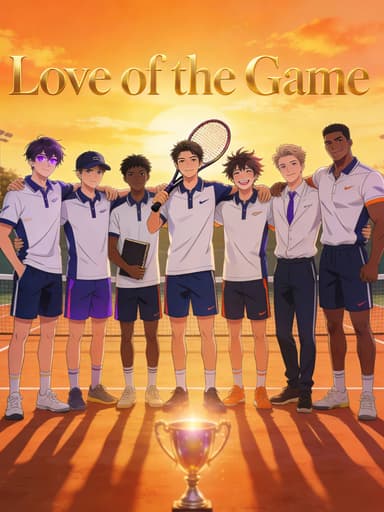
Love of the Game
- 👁 699
- ⭐ 7.0
- 💬 72
Annotation
He died a champion. He woke up a child. This time, he plays for keeps. Alex Irvine was a tennis prodigy on the verge of greatness—until a plane crash ended everything. When he opens his eyes, he is no longer Alex. He is a three-year-old boy in a coastal Japanese town, with a second chance at life, a new family, and a racket in his hands. But some things never change. The hunger for victory. The fire on the court. The dream of standing on the world's biggest stage. From the sun-drenched courts of Rockport to the elite Westbrook Academy, Alex builds something greater than individual glory: a team. Together with a group of fiercely talented, wildly unpredictable teammates, he will chase a championship no one thought possible. Yet shadows from his past linger. The rivals who once defined him. The secrets he carries. And the one opponent he may never be ready to face—himself. Love of the Game is a heart-pounding, emotional journey of redemption, friendship, and the relentless pursuit of greatness. For anyone who believes that sometimes, one life isn't enough to achieve your dreams. They said his time was over. They had no idea it was just beginning.
Chapter 1
June in London was never particularly scorching, and true to form, the rain began to fall before the match even started.
Rain seemed an inseparable companion to Wimbledon, yet the drizzle would not deter the spectacle about to unfold.
Elian Thorne sat quietly in the locker room, scrolling through the photo gallery on his phone. It contained his only fragments of genuine happiness. In the picture, a rare smile graced his face as he held the National Junior Championship trophy. Beside him stood his grandfather, Arthur, his hand resting gently on Elian’s head with affectionate warmth.
*Grandpa, I’m going to win this one for you, too.*
The sudden ring of his cell phone shattered the moment. Elian stared at the flashing name on the screen—*“Mom”*—a label that brought nothing but irritation. He declined the call and, to prevent further disturbance, powered off the device entirely. He stood up to finish his warm-up routine in the quiet room.
This match was destined to capture the world’s attention. A prodigy at just fifteen, Elian had already conquered the French Open Junior Championship and was now storming the hallowed grass courts of Wimbledon.
Meanwhile, commentary teams back in the States were broadcasting live.
“Elian Thorne looks remarkably composed out there,” one commentator noted.
“Absolutely,” the other replied. “He’s prepared extensively for today. But notice, he’s entirely alone in the player’s box. No family, no coach entourage.”
“Do you think the isolation will add psychological pressure? He’s playing against a local British favorite, Roland. The crowd is heavily biased against him. It’s a hostile environment for the young American.”
Clad in pristine white tennis whites, Elian stepped onto Court One. The roar of the crowd washed over him, but his mind was a fortress.
*Even if I’m alone, I will win.*
The match concluded to a thunderous standing ovation.
But Elian heard none of it. His mind was consumed by a singular need: to share the victory with his grandfather. He had fought alone, won the championship, and now, he departed in silence.
Media crews scrambled to interview the youngest Grand Slam junior champion in history, only to be told he had already vanished from the grounds.
On the drive back to the hotel, Elian switched his phone back on. A deluge of notifications flooded the screen—over a hundred missed calls. A knot of dread tightened in his stomach.
A second later, the phone rang again. That same name. He pursed his lips, hesitated for a heartbeat, and then answered.
“Where the hell have you been? Do you have any idea how many times I’ve called? You’re just as useless as your dead father…”
Elian was immune to such venom. He cut her off, his voice flat. “What do you want? If it’s just to insult me, I’m hanging up.”
The woman on the other end seethed at his indifference. “You ungrateful brat! Get your *ss back here immediately. The old man is on his deathbed. He wants to see you one last time—probably to sign over that inheritance. If you don’t get here and play the part of the grieving grandson, we’ll be left with nothing in the Thorne family hierarchy.”
Elian let out a hollow laugh. “You’re just a mistress who clawed her way into a marriage, dragging a baggage kid along with you. You think you deserve a place in that family? You think you deserve his money? It’s pathetic.”
He ended the call without waiting for a response, leaning his head against the rain-streaked car window. The storm outside was intensifying.
Honestly, he barely remembered his father’s face. There were fragments of kindness, perhaps, before the man’s professional tennis dreams shattered. After that, Elian’s memories were reduced to the stench of alcohol and the bruises of domestic violence.
He had picked up a racket only to please that man. He wasn’t a genius; the media had it wrong. Every victory was paid for in blood and endless, grinding practice. When he started winning titles, the man became marginally kinder, but death took him when Elian was ten anyway.
That woman—his mother—had dragged him into the Thorne household as a “bonus” package after the original wife died. She sought status, while Elian sought only survival.
Despite the chaos of his life, he had one thing to thank her for: bringing him to the Thorne estate. His stepfather was strict but fair, and his stepbrother, despite the family drama, never took his anger out on Elian. But it was Grandpa Arthur who was his true light. Without that old man’s encouragement, Elian would never have stepped onto a world stage.
Hearing that Arthur was critical, Elian booked the first flight out. He had to tell him about the trophy.
*I will win. I will get all four Grand Slams. You have to hold on, Grandpa. You have to see it.*
Elian skipped the awards ceremony. While the global media speculated on his whereabouts, tragedy struck.
A flight from London to New York, caught in severe atmospheric turbulence, went down over the Atlantic. Elian Thorne, the rising star who had just conquered Wimbledon and Roland Garros, was listed among the lost.
Elian felt like he was trapped in an endless dream. His father’s violence, his mother’s curses—they suffocated him like deep water.
He had pitied that woman once, tried to make her happy, but it was futile. She used him as a pawn against his stepbrother, filling his schedule with etiquette, piano, and tutors. He was a machine, stripped even of the choice of what to eat.
Grandpa Arthur had been his only beam of light. Now, that light had extinguished.
Elian felt himself sinking into the abyss, but just as the darkness threatened to consume him, a hand grabbed his.
*Warm.*
He clung to it desperately. When he finally opened his eyes, the world was wrong.
He remembered the plane tearing apart. Was he a survivor? No… this wasn’t a hospital.
A rough, calloused hand brushed across his forehead.
“*Alex, how are you feeling, piccolo?*” a gentle voice asked.
Elian stared at the hand he was gripping, following it up to the face of a kindly old man. The language… it was Italian. He knew a few phrases, but not enough.
*Italy? Did I wash up on the Italian coast?*
The old man, seeing the boy’s silence, assumed the fever still had its grip. He scooped Elian up and rushed him to a local clinic.
It wasn’t until they returned to the small, sun-drenched cottage that Elian realized the truth. He was no longer Elian Thorne. He was inhabiting the body of a toddler.
His name, it seemed, was Alessandro—*Alex* Moretti.
It took three days for Elian to accept his new reality. He felt no joy, no sorrow, just a calm acceptance of the miraculous. The old man was his grandfather, a carpenter by trade. As for Alex’s parents? They were ghosts—nowhere to be seen.
Elian wanted to ask, but the language barrier kept him silent.
His new grandfather, seeing the boy sit vacantly in the courtyard, often sighed. Three-year-old Alex had fallen into a lake three days prior. By all rights, he should have drowned. His survival was a miracle, but the old man feared the lack of oxygen had damaged the boy’s mind.
Doctors, however, found nothing physically wrong. The diagnosis was traumatic mutism—shock induced by the near-death experience.
In truth, Elian just didn’t know the words.
This strange new world kept him confined. The grandfather, fearful of another accident, built a sanctuary around him. Elian quickly realized the nature of the old man’s craft: he was a coffin maker.
It was a somber trade, but the old man’s hands were kind. In his spare time, he carved toys.
“*Alex, look,*” the grandfather said one afternoon, pointing to a finished rocking horse. The wooden figure swayed gently. “*Do you like it?*”
Elian stared at the horse. It took him a moment to understand the gesture. Blushing slightly at his own awkwardness in this tiny body, he climbed onto the saddle.
The rocking motion was soothing. Despite being fifteen in his mind, the simple joy of the moment broke through his stoicism. He rocked back and forth, a genuine smile touching his lips.
The grandfather sat close by, hands ready to steady the boy, watching with a protective gaze.
Elian Thorne began to adapt. The quiet life of the Italian countryside was a stark contrast to the cutthroat world of professional tennis. It felt like a dream.
When his grandfather worked, Elian sat nearby, handing him scraps of wood or tools. Often, he ended up covered in sawdust, prompting the old man to scoop him up for a thorough washing.
“*Go play over there, Alex. Careful of the splinters.*”
At first, the clumsiness of a toddler’s body frustrated him, but the affection he received was a balm he had never known.
They lived in the remote countryside. Evenings were spent by the edge of the fields, chasing fireflies under a canopy of stars. The croaking of frogs and the cool evening breeze washed over him.
Watching the blinking lights of the fireflies, Elian smiled.
*Elian Thorne is dead,* he thought.
*I am Alex Moretti.*
Chapter 2
Hearing the voice, Alex snapped out of his daze. Although he couldn’t understand the Italian words his grandfather spoke, his body moved on instinct. He toddled over, short legs pumping, and wrapped his small arms around the old man’s leg, looking up with a beaming smile.
Seeing that grin, the grandfather chuckled and scooped the boy up effortlessly. Alex instinctively hooked his small arms around the old man’s neck.
“Off we go, my little Alex. Let’s go catch some fireflies,” the old man said warmly, carrying the boy out into the twilight fields to play.
In the blink of an eye, over a month had passed.
For Alex, this time was the happiest he had ever known, yet a nagging trouble persisted: he was still functionally illiterate in this country. He couldn’t understand the rapid Italian his grandfather spoke, nor could he reply. It was frustrating. He often worried his vocal cords had been damaged in the drowning, but in the privacy of his room, he could speak fl
Reviews
See All
Bubble Tea
You will also like











Use AlphaNovel to read novels online anytime and anywhere
Enter a world where you can read the stories and find the best romantic novel and alpha werewolf romance books worthy of your attention.


 Scan the qr-code, and go to the download app