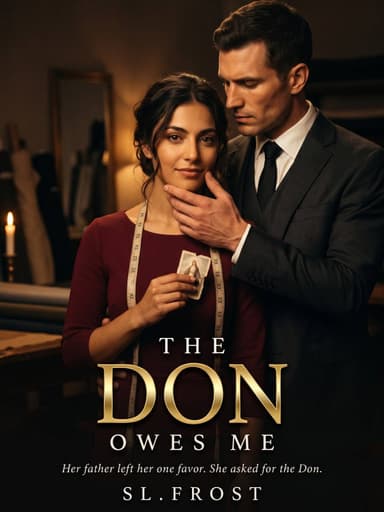
The Don Owes Me
- 👁 4
- ⭐ 6.0
- 💬 0
Annotation
At my father's wake, my fiancé broke our engagement in front of the whole family. "The tailor's deal died with the tailor," he said, and every captain at the bar raised a glass to it. Then I found what my father had sewn into the lining of his jacket. Half a holy card. Saint Lucy, torn down the middle, signed by the old Don twenty years ago, on the day my father stepped in front of a bullet meant for him. A marker. The family's oldest promise: anything you ask, once. So I walked the length of that room, past my ex and his new bride and every man who'd laughed, and I laid it on the table in front of the most dangerous man in Halverport. "I want a husband," I said. "You." Saverio Varallo didn't laugh. He reached into his jacket and took out the other half of the card. He'd carried my father's debt over his heart for nine years. Now I sleep down the hall from the Don. I sit at his right hand while the men who laughed plot to break us in forty days. I'm a tailor, so I notice things: the wire sewn into a wedding suit, the green thread in my father's last job, the way my husband counts the stairs in the dark. The Don has a secret he's never told a soul. And my father didn't die of a weak heart.
Chapter 1: The Lining
I shortened my own funeral dress at four in the morning, and I cut it too short.
I knew it the second I stood up. Half an inch, maybe five eighths, and my father would have seen it from across the street and said nothing until I’d had my coffee, and then he’d have said, very gently, “Ilaria, the floor is not your enemy.” He believed every young tailor cut short because she was afraid of the floor.
He’d been dead four days, and I could still hear him perfectly.
The Varallo house was full by six. It always was for a wake, because the Don paid for the food and the Don’s food was good. My father had cut suits for that family for thirty years, so they gave him the big room with the piano and the buffet, and the photograph of him at his cutting board with chalk behind his ear, looking startled that anyone had pointed a camera at him.
I stood beside the photograph and shook hands until my fingers went numb. Tullio, the Don’s driver, who is the size of a door and had already cried twice before seven, told me my father never once got his trouser length wrong.
“He let out my jacket three times,” Tullio said. “Didn’t mention it. Not once! Just let it out.”
“He liked you.”
He wiped his eyes with a scarf he’d crocheted himself. It was purple and very uneven. “I’m sorry, Ilaria. I’m so sorry.”
I was wearing my father’s tweed jacket over the dress. It hung off my shoulders by a good two inches, and it smelled of pressing steam and the pipe tobacco he’d given up in 2019. Nobody mentioned it. What do you say to a girl at her father’s wake whose jacket doesn’t fit?
My phone buzzed against my hip for the ninth time.
PIA: Your uncle is by the shrimp asking people about “the paper.”
PIA: What paper??
PIA: Also Remo just walked in with a Sparano.
I looked up.
Remo Varallo stood in the doorway in the navy suit I’d made him, and he looked very good in it, because I’m good at my job. He’d been my fiancé for two years. Beside him, in black silk that cost more than my shop earned in a month, stood Delfina Sparano.
She wasn’t holding his arm. I noticed that first, the way I notice a bad seam. He was holding hers.
“Remo,” I said, when he finally reached me.
“Ilaria.” He kissed my cheek. He smelled of a cologne I hadn’t bought him. “I’m sorry about your dad.”
“Thank you.”
“Can we talk? Just for a second?”
We walked to the window. Outside, the harbor was black and the cranes were lit up red. He put his hands in his pockets, and I watched the jacket pull across his back. I’d cut that back. Why did it suddenly look like a stranger’s?
“This is hard,” he said.
“My father’s dead, Remo. It’s all hard.”
“Yeah. Yeah, it is. That’s why I wanted to do it properly.” He glanced back at the room. “The thing is, the Sparanos and us, it’s a big deal. The port. My uncle needs it. Ottavio says it’s the best match this family’s had in twenty years.”
I waited. What else was I supposed to do?
“I’m marrying Delfina,” he said.
My father, in the photograph, went on looking startled.
“You’re telling me this at his wake.”
“I’m telling you before you hear it from someone else.” He said it as though I ought to thank him for it. “It was always going to be weird with us. You know that. Your dad was the tailor. He was family, sure. But…”
“But.”
“But he’s gone now. Whatever deal he had with my grandfather, that died with him.” He shrugged. “So there’s no reason to keep pretending, is there?”
Pretending? Was that what the last two years had been? I stood there with the whole of English and half of Italian in my head, and not one word of either would come out.
Then he turned and said it again, louder, to the room.
He didn’t mean to, I’ll grant him that on a generous day. He meant it for Delfina’s father, right behind us. But the piano had stopped, and Remo has the kind of voice that carries to the back pew.
“It’s done, Mr. Sparano. I told her. The tailor’s deal died with the tailor.”
One of the captains by the bar lifted his glass. “To the tailor’s deal,” he said. “May it rest in peace!” Two more raised theirs and drank, and the joke went down the bar from hand to hand, and I felt it on my face like a steam iron held an inch too close.
Across the room Tullio took a step toward the bar, his big face gone dark. At the far end of the long table, without even looking up, the Don lifted one finger off the cloth. Tullio stopped as though he’d walked into a wall.
Nobody else noticed, but I did. I always notice hands, because hands are half of a fitting.
Delfina Sparano noticed too. She was watching me over the rim of a glass she hadn’t drunk from, and there was no laugh in her face and no kindness either. She looked like a woman doing sums.
My uncle Nunzio pushed through to me with shrimp on a napkin.
“Ila. Ila, sweetheart. Did your father leave you any paper? Any kind of, you know…” He lowered his voice, which meant everyone heard it. “Because if there’s paper, that’s family business. That should come to me.”
“There’s no paper,” I said.
“You’re sure? You checked the safe?”
“Uncle Nunzio!”
“I’m asking for you!”
I pushed my hands deep into my father’s jacket pockets so nobody would see them shaking.
The left pocket held the tobacco. The right held his chalk, a yellow stub worn down to the size of a fingernail. And under the right pocket, against my hip, the lining was wrong.
I’m a tailor. I can feel bad stitching through a winter coat. Someone had cut this lining open and sewn it shut again, a patch three inches long, and the stitches weren’t his. They were too tight and too careful, the stitches of somebody who didn’t trust their own hands anymore, and underneath them something was stiff, like card.
My father hadn’t trusted his hands for a year, not since they’d started to shake.
I took my little thread-cutter out of my bag, the way other women take out lipstick, and opened the lining right there by the window. Remo was busy with Delfina’s father, Nunzio with his shrimp. Who watches the tailor’s daughter fixing her jacket?
Inside was half a holy card in a sleeve of wax paper.
Saint Lucy. I knew her from church. She held a dish with two eyes on it, which frightened me badly when I was small. The card had been torn straight down the middle, so I had her face, one eye on the dish, and half a signature in old brown ink across the tear. Amadeo Var…
Oh, I knew what it was. Everybody under that roof knew what it was, the way you know the name of an illness.
Twenty years ago my father took a bullet in the shoulder at the Varallo Feast. He’d stepped in front of Don Amadeo without thinking, he always said, the way you’d catch a roll of cloth falling off a table. The old Don gave him a marker for it. Anything you ask, once. The family’s oldest promise. It didn’t die with a man, because a man didn’t owe it. The chair did.
He never used it. When I was little I used to ask him why not, why didn’t he ask for a car, a house, a new boiler, anything at all?
“Because the day you need it,” he’d tell me, “is a very bad day.”
Was this the very bad day, Papa? Was this what you meant?
I walked past Remo. I walked past Nunzio and his napkin and the captains at the bar, who had slowly lowered their glasses because they’d seen what I was holding, and I walked the whole length of that room, with my too-short dress and my father’s too-big jacket and my heart going so hard I could feel it in my teeth, and I stopped in front of the man at the far end.
Saverio Varallo hadn’t stood up all evening. He sat with his back to the wall, as he always did, in a black suit my father had cut for him, a touch fuller on the left where he carried what he carried. He was thirty-four, and he’d been Don for nine years.
Ottavio Rocca sat at his elbow, peeling an orange with his thumbnail. He looked up at me with soft, worried eyes, the way a kind uncle looks at a girl who’s had too much wine, and he shook his head a tiny fraction. Don’t.
I’d measured Mr. Rocca for six suits, and he’d never once tipped my father.
The Don watched me come, and he didn’t look at the card. He looked at my face.
I laid the half of Saint Lucy on the white cloth in front of him.
The room went quiet enough that I heard the refrigerator humming in the kitchen.
“Miss Benedetti,” he said.
“My father left me this,” I said. “So it isn’t dead. And it isn’t his deal. It’s yours.”
“It is.” He didn’t touch it yet. “What do you want?”
Behind me Remo said, “Ila, come on. Don’t do this here.”
I didn’t turn around. I’d done what Remo wanted for two years, and I was finished with that, right now, at this table.
What did I want? Money? The shop needed a new boiler and the press was older than I was. I thought about my father’s hands shaking over a buttonhole, and every man in that room who’d toasted a dead tailor’s deal, and what one single thing would stop all of them from ever raising a glass at me again.
“I want a husband,” I said. “You.”
Nobody breathed.
Saverio Varallo reached into the inside pocket of his jacket. He took out a flat leather wallet, and from it, in its own sleeve of wax paper, the other half of Saint Lucy. He’d been carrying it. For nine years he had carried my father’s debt against his heart, and I hadn’t known, and how could I not have known?
He laid the halves together on the cloth. The tear matched. Her face, her dish, both eyes. The old Don’s full name ran across the join.
And then the captain who’d started the toast threw back his head. “The tailor’s girl wants the chair!” he said, and his friend snorted into his wine, and a ripple went down the room, nervous and ugly, the laugh of men who didn’t know yet which way to jump and had decided to jump at me.
I waited for the Don to stand. Everyone did. When the Don stands, the room stands, and the laughing stops.
He didn’t stand.
He sat back in his chair and let them laugh. He let it go on until it ran out by itself and the men who were laughing could hear how alone they sounded. Then he spoke, quietly, and the whole room leaned in to catch it.
“The chair pays,” he said. “It always pays. But a marker buys one thing, Miss Benedetti, and it doesn’t buy it cheap. So before you say yes, you should hear the price.”
“Tell me,” I said.
“You marry me in front of every man in this room. You sit at my table, at my right hand, where they can all see you. And when they come for you,” he said, so calmly, as if he were reading me the weather, “and they will come for you, you don’t run home to Vesta Street. Not once.”
He looked past me then, down the long room, at the captain with the glass. The captain set his glass down slowly on the bar, as if it had suddenly got hot.
“That’s the price,” Saverio said. “Can you pay it?”
Could I? I had no idea. I’d never been brave in my life, I’d only ever been stubborn, and my father always said those were cousins who didn’t speak.
But my knees had gone to water, and my voice hadn’t.
“I’m a tailor,” I said. “We stand for hours. I’m not going to run.”
Something moved at the corner of his mouth, not quite a smile, more the place where a smile would go if he ever let one out.
“Then it’s done,” he said, and with one foot he pushed out the empty chair beside him, the one at his right hand, where nobody ever sat.
I sat down in it. In front of everyone.
“Ilaria,” I said. “My name is Ilaria. You’ll need it for the vows.”
Chapter 2: Measurements
Tullio drove. Saverio sat in the back with me, which I hadn’t expected, and for the first eleven minutes neither of us spoke.
I counted them on the dashboard clock, because it was that or think.
The car smelled of new leather and Tullio’s peppermints. Out of the window Halverport went by in pieces: the shut bakeries, the fish market with its hoses running, the bus shelter on Corso Street that someone had painted gold as a joke and the city had never painted back. My phone vibrated in my bag like a trapped bee.
“You can answer that,” Saverio said.
“It’s my cousin.”
“Then you should definitely answer it.”
I looked at him. He was facing the windshield, and if that was a joke, it hadn’t moved his face at all.
PIA: ILARIA.
PIA: ILARIA BENEDETTI.
PIA: Did you just propose to the DON?
PIA: Aunt Carmela fainted into the cannoli. Not a metaphor.
PIA: Are you okay? Tell me you’re okay.











Use AlphaNovel to read novels online anytime and anywhere
Enter a world where you can read the stories and find the best romantic novel and alpha werewolf romance books worthy of your attention.


 Scan the qr-code, and go to the download app