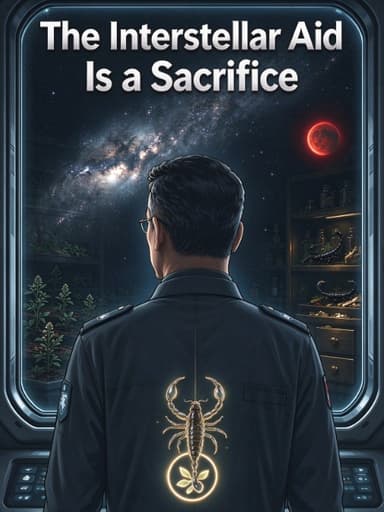
The Interstellar Aid Is a Sacrifice
- 👁 0
- ⭐ 5.0
- 💬 0
Sinossi
Dr. Fang, a top Chinese medicine epidemiologist on Earth, is tasked with leading humanity’s first extraterrestrial aid mission. A strange virus carried by meteorites has swept across the Milky Way, pushing the medical system of Proxima Centauri to the brink of collapse. Humans have unexpectedly developed immunity. One hundred medical elites board a starship, traveling 4.22 light-years to Proxima Centauri. Before departure, his wife stands in her medicinal field and asks if he will return. Once a brilliant classmate, she refused to learn the interstellar common language, dropped out of university, and retreated to her farm to grow herbs and raise scorpions. She opposes interstellar expansion, and Dr. Fang sees her as a leftover of a bygone era. During the eighteen-day voyage, the loneliness of space stirs his memories. Diplomat Charles keeps raising suspicious questions. As they draw near Proxima Centauri, the myth of peaceful interstellar civilization shatters. This highly anticipated interstellar aid mission has been a carefully laid trap from the very start. His wife’s old fable about scorpions foresaw humanity’s fate all along.
Chapter 1 The Farewell
Dr. Fang, this is Earth's first extraterrestrial medical relief mission. We are counting on you.
The words reverberated endlessly inside my skull, ringing over the low, persistent hum of pre-launch machinery. Beneath my boots, the reinforced concrete of the launch facility trembled with the dormant power of the starship, as though the entire earth beneath it were holding its breath. I stood at the observation window, watching the morning light slant across the tarmac, and I felt, for the first time in my life, the full, crushing weight of what I was about to do. As Earth's leading epidemiologist — a specialist in traditional Chinese medicine who had spent three decades bending over microscopes and ancient herbals alike — the burden of this mission rested squarely, immovably, on my shoulders.
From the moment the mission order had landed on my desk, I had allowed myself no reprieve. I had coordinated with my team in sterile white briefing rooms lined with glowing data screens, their hums a constant lullaby to my fraying nerves. I had finalized all departure clearances, verified stacks of voyage documentation, double-checked and triple-checked the manifests, and packed my gear inside a reinforced alloy case that felt far too heavy with the weight of human hope. Once every detail had been settled, once there was nothing left to arrange and no excuse remaining to delay, I lifted my eyes to look at her.
It was a gaze separated by years. I had not truly seen my wife in a very long time.
She stood at the edge of her farm, beneath a bleached, cloud-streaked sky, wearing a frayed straw hat whose brim had been worn thin by a decade of harsh sunlight. The morning gilded the dry edges of that hat, and her sun-weathered face sat half-hidden in shadow, her expression unreadable. Only her eyes were clear — burning with a raw, urgent longing that I had not expected, that I had forgotten she still possessed. Behind her, the swaying green of her medicinal herbs stretched toward the distant treeline, row upon row of quiet life she had planted with her own hands.
"Will you come back?" she asked.
The question hung in the air between us like something heavy and physical. Even now, she could not grasp the reality of our age. To her, a voyage to the stars still meant a lifetime apart, an open-ended crossing that might never be reversed. I wanted to explain to her — to tell her that eighteen days of travel separated us from Proxima Centauri, that the Starweb would let us speak daily, that the age of lonely treks had ended centuries ago. But I was tired. Months of frantic preparation had worn me thin, and I had no patience left for her old-fashioned fears.
"I will," I answered, dismissive, unwilling to unpack the details.
My wife said nothing more. Her silence surprised me. I had expected argument, perhaps, or tears — something to justify the irritation I felt building behind my ribs. Instead, she simply turned her gaze away, and in that single motion I caught, for the barest instant, the word *aging* cross my mind.
Staring into her eyes, I understood that human aging was not merely etched into flesh. It lived in the gaze itself. Hers was tangled with exhaustion, worry, resentment and quiet loss — a weariness accumulated year after year, thick as miasma hanging over the damp soil of her herb beds, threatening to suffocate me. I had put that weariness there. We had been falling short of each other ever since our university years, and I had let the distance grow until it became an ocean.
Back then I had been young, hungry for ambition, my heart fixed on the stars. She had been the brightest student in our traditional Chinese medicine cohort, and I had loved her for the fierce, quiet way she held to her convictions. We had been so alike then — or so I had believed. But time had carved us into strangers.
At last, my wife turned and walked back into her farmland, her figure slowly swallowed by the rows of herbs, never glancing over her shoulder. I watched her go, and something in my chest tightened — a sensation I refused to name.
I tapped my forehead, snapping back to the present, and peered out the starship's reinforced porthole. That blue homeworld had already shrunk far into the distance, its soft white cloud swirls diminishing into a fragile marble suspended in the black. Mission control ordered me to lower the tinted sunshade; the ship was accelerating, preparing to swing past the Sun, whose searing white corona blazed against the void like a wound in space. I severed the final thread of longing and turned to survey the cabin.
Warm artificial lighting washed over rows of padded seats, storage lockers and holographic workstations. It was filled with my compatriots. Before leaving Earth, we had hailed from every corner of the globe — Asian, African, European, countless ethnicities and countless languages. But once we crossed beyond our homeworld, we shared one name: *human*.
This was Earth's first elite medical relief team bound for the stars. One hundred specialists had boarded this starship, crossing the endless, cold void toward our destination beyond the Solar System: Proxima Centauri. We carried with us the accumulated medical knowledge of our species, the distilled hope of four centuries of interstellar contact, and the silent prayer that we were doing the right thing.
I did not know, then, how wrong we were. None of us did.
Chapter 2 The Age of Cosmic Openness
Centuries ago, commercial space travel had become commonplace. Earth had gradually joined the interstellar community, breaking through technological barriers, unraveling the secrets of relativistic travel, and entering an era of explosive advancement. Glass spires pierced Earth's atmosphere; automated farms stretched across former deserts; cities of light rose where wilderness had once stood. Our civilization had surged forward with the momentum of a falling star, and the old age of isolation — shackled, as we had believed, by limited technology — was long gone.
Peaceful opening to the cosmos had brought humanity all the rewards of this new age. We traded with distant worlds, shared knowledge across the Starweb, and basked in the illusion that we had finally found our place among the stars. It was a beautiful dream, and we had believed every word of it.
After centuries of interstellar diplomacy, humanity had slowly learned that our greatest fear was born from the unknown



Usa AlphaNovel per leggere romanzi online quando vuoi e dove vuoi
Entra in un mondo dove potrai leggere tante storie e trovare i migliori romanzi d’amore e libri romantici con lupi mannari alfa che meritano la tua attenzione.


 Scansiona il codice QR e vai al download dell'app