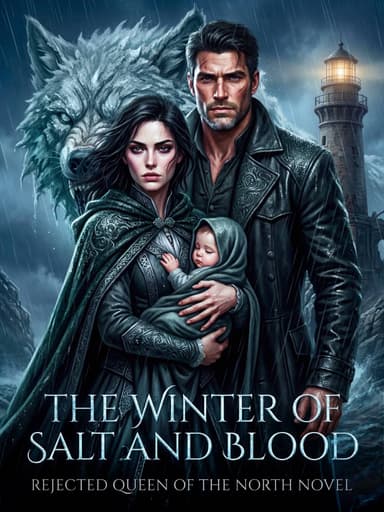
The Winter of Salt and Blood
- 👁 920
- ⭐ 7.5
- 💬 24
Annotation
Ísla Vael was raised to be useful. As the eldest daughter of House Vael, she learned how to read alliances, obey power, and survive the kind of world where daughters are turned into instruments. But when she steals an infant from House Dorn and disappears into the western dark, she does the one thing her family never expected: she chooses something for herself. The child she carries is not ordinary. Mira is a bloodline infant, born with a power the old order wants erased before it can grow. And Kas Morvein, the most dangerous hunter on the western routes, has been paid to find Ísla and bring her back. He should return her. Instead, he follows. As Houses close in and ancient forces begin to stir around the child, Ísla and Kas are driven north across ruined roads, marshes, and hostile territory toward the only place that may still protect girls like Mira. But the closer they get, the more dangerous the road becomes — and so does the bond growing between them. Because Kas is not only the man sent to hunt her. He is also the first man who sees what she is beneath everything her father tried to make her. Now with enemies behind them, power waking in the dark, and a child who could change the future of the North, Ísla must decide who she will be when the running ends. Because some women are raised to be used. Others survive long enough to become impossible to control.
Chapter 1 - The Theft
The child didn't cry.
That was the first thing — the thing Ísla had not planned for, in the hours she'd spent planning everything else. She had accounted for noise. Had rehearsed the route assuming noise, with a wailing infant on her chest and House Dorn's night guards doing their rounds on the forty-count. She had stolen from House Dorn before with less preparation and a louder conscience, and she had been fine.
But Mira looked up at her from the cradle with eyes that had no business belonging to an eight-month-old face, and did not make a sound.
Ísla stood in the dark of the nursery for three seconds longer than she'd allocated, simply staring back.
Then she strapped the child to her chest and climbed out the window.
The cliff path was a Dorn secret and therefore not a secret — she had found it in the trade records, buried in a line about supply drainage, the kind of notation her father used when he was hiding something in plain sight. She had spent two years memorizing her father's notation systems. She had spent the years before that learning to smile at the men across the table whose handshakes sealed her future. She had not wasted any of the education, even the parts that were intended to cage her.
The path was narrow. The drop to her left was somewhere between catastrophic and final, and the wind coming off the water had teeth. She kept her shoulder against the rock face and moved steadily, one hand braced on stone, the other pressed flat against Mira's back. The child's weight was warm and solid against her sternum. Eight months old and already the heaviest thing Ísla had ever carried.
She was twenty feet from the path's end when she heard him behind her.
Not the guards. She knew the guards' pattern — she had spent four days in Dorn's port town watching the shift change, eating bad fish, cataloguing the timing in her head. This was one person, unhurried, not hiding. The specific sound of someone who knew she'd heard them and had decided it didn't matter.
She stopped. Put her back to the rock. The child between her body and the stone, her knife in her right hand, the drop at her left shoulder.
He came around the last bend at a walk. Tall. Older in the face than the shoulders suggested. Three days of stubble going silver at the jaw. He stopped six feet away and looked at her with the quality of attention she associated with men who charged high rates for specific work, and he said nothing at all.
"House Dorn hired you," she said.
"No."
She watched his hands. Knife on his belt, not drawn. Crossbow on his back, not unslung. He stood with the stillness of someone who had been in worse positions than this and found them instructive.
"Then who."
"Someone who wants you found," he said. "Not the child."
Mira shifted against her chest. Ísla kept her eyes on him. "Found," she repeated. "That's a clean word for it."
"I pick clean words." He looked at the child, brief, then back at her face. Something moved in his expression that she didn't have a category for. "They didn't tell me about her."
"And now that you know."
He was quiet for a moment. Wind off the water, the distant sound of the sea against the cliff below. "They want you returned," he said. "They said nothing about a child. As far as my contract is concerned, she doesn't exist."
"That's convenient."
"It's accurate." He looked at Mira again, longer this time. The child was watching him with those too-old eyes, perfectly still, one fist curled against Ísla's collarbone. Something crossed his face that he didn't manage to file away fast enough. "The Houses have been looking for you for ten days," he said. "I found you in four. The next man they send will be faster."
"Or slower."
"Not slower." He said it without arrogance. Just the specific flatness of a true thing stated. "I'm the best they can hire on the western routes. The man after me will be a House soldier with a standing order and no particular interest in what happens to a bloodline infant."
The wind picked up. She held the child tighter and kept her face neutral and thought: ten days. Four days to find me. She had been careful. She was always careful. She filed this away too — not alarm, not yet, just data.
"You're telling me this," she said.
"Yes."
"Why."
He looked at her for a long moment. Then he said: "I don't know yet."
It was the wrong answer, which meant it was probably true. She had spent twenty-six years being told the right answer by men who had already decided what she was useful for. She recognized the texture of it. This was different. She catalogued the difference and kept her knife where it was.
"There's a path down to the cove," she said. "Not the main road."
"I know. I came up it."
"You could have waited at the bottom."
"Yes."
She looked at him. He looked back. Three feet of dark and cold wind between them, a cliff at her left, a dead-end path behind him, and an eight-month-old child pressed between her body and the rock who still had not cried.
"If you follow me," she said, "it's not for them."
"I know."
She held his gaze another three seconds. Checked the calculation: his hands, his position, the crossbow, the knife, the drop, the path, the thirty miles of unwatched road between here and anywhere that wasn't Dorn territory. Checked it again. Filed the conclusion under already decided because that was the only column that moved her forward.
She took her back off the rock and walked past him toward the path's end.
He fell into step behind her. Not close — appropriate distance, no crowding. She could hear him but not feel him. She counted his footsteps and mapped his gait automatically, the way her father had taught her, and noted that he made almost no sound for a man his size.
They made the cove. The boat was where she'd left it, tied to a rusted ring hammered into the rock face, bobbing in the dark water. She stepped in, settled the child, unwound the rope. When she looked back he was standing at the water's edge.
"Coming?" she said.
He got in without asking where.
She rowed. He did not offer to take the oars and she did not offer them. He sat in the bow with his elbows on his knees and watched the dark water and said nothing, and she found that she was listening for the quality of his silence rather than the absence of it. There was a difference. The silence of a man planning something and the silence of a man simply being in a place were not the same, and his was the second kind. She had not met many of those.
Mira slept between them, wrapped in the blanket Ísla had taken from the nursery — good wool, Dorn red, she would have to get rid of it — and did not stir when the boat scraped the far shore.
She had a fire going in forty minutes. He gathered wood without being asked and did not comment on where she chose to make camp, which told her he would have chosen differently. He was reading the terrain the way she was. Filing the same data points in different columns.
The child needed feeding. She unstopped the small clay flask she'd taken from the nursery stores and tilted it carefully, and he went to the fire, which she noted.
When she turned back he was sitting with his arms across his knees, looking at the flames.
"Name," she said.
He glanced over. "Kas."
"House?"
"No."
She had guessed that. No House meant no allegiance, which meant no loyalty to report to, which was either better or much worse depending on what he was working from. She looked at the child, at his face, back at the fire. "I'm Ísla."
"I know."
"From the contract."
"From before the contract." He said it without emphasis. "House Vael. Eldest daughter. Four languages, Salt House law, alliance architecture. Your father's most expensive instrument."
She kept her face even. "You did your research."
"I do it before, not after."
"And the child?"
He was quiet for a moment. "Bloodline carrier," he said. "Minor western family. The House that held her is Dorn-affiliated but not Dorn — they were keeping her for someone else. The man who hired me didn't mention her, which means either he didn't know about her or he wanted to see what I'd do when I found her."
"Which do you think?"
"I think he didn't know." He looked at Mira. "If he'd known about the child, he'd have sent someone who cares less."
She let that sit. Fed the fire a stick. The child had gone still in her arms, that particular heaviness that meant sleep, and Ísla shifted her weight and felt the knot in her left shoulder and thought about the forty miles still between her and any semblance of north.
"You have a wound on your side," she said. "Left, under the ribs. You've been compensating since the cliff."
He looked at her.
"You're good at it," she said. "I almost didn't catch it. But you stepped wide on the rock outcrop at the cove — you wouldn't have if you were moving freely."
A beat. Then: "Rock from two days ago. It's already closed."
"I'll be the judge of that."
He studied her for a moment with that quality of attention again — reading, cataloguing, the same thing she did and the recognition of it was strange. Then he pulled up his shirt.
The wound was closed but livid, the skin tight and too warm when she pressed the edge of it. Not infected yet. She worked without speaking, cleaned it with what she had, and he sat still with the unsettling quality of a man who had been hurt in worse places and found this merely procedural.
"You're good at that," he said.
"My father's instrument needed to be self-sufficient," she said. "In case the instrument was damaged in transit."
He said nothing. She pulled the linen tight and knotted it and sat back on her heels and looked at him in the firelight and thought: I do not know what you are yet. It was the first time she'd thought that about anyone in years. Usually she knew within the first two minutes. Usually she had to know, because the knowing was the only thing that kept her ahead.
She did not know what to do with not knowing.
"Sleep," she said. "I'll take the first watch."
He lowered his shirt. Looked at her. "You're not going to ask me to leave."
"I'm going to ask you to be useful," she said. "Those are different things."
He lay down on the far side of the fire. She sat with the child in her arms and watched the darkness beyond the trees and listened to the sea, and at some point she became aware that she had stopped calculating exits.
She started again. The habit was too old to break in one night.
But she noticed the gap.
An hour before dawn the Salt Wolf came.
She heard it before she saw it — wrong silence, the specific absence of wind, the water going flat and then the smell of it, salt and old stone and something underneath that had no name in any of the four languages she'd been taught. The child woke. Not crying — just awake, eyes open in the dark, one fist pressed to her own sternum.
Kas was on his feet before she spoke. She hadn't heard him move.
It came out of the water like a thing that had always been there and had simply decided to become visible. Pale as fog, vast, patient — not aggressive, not afraid, not anything she had a word for. It stood at the tree line and looked at the child and the look was the most specific thing she had ever seen on an animal's face.
Kas stepped between her and it.
She almost told him not to. She almost said: I don't need that. But she looked at his back, at the set of his shoulders, at the quality of stillness in him — not frozen, not performance, the genuine absence of fear — and she didn't say it.
The Wolf looked at Kas. Then at Ísla. Then at the child again. Then it turned and walked back into the water and was gone.
The wind came back. The sea resumed. Mira lowered her fist and closed her eyes.
Kas turned around. He looked at the child first, then at her.
"That wasn't in the contract either," he said.
"No," she said. "It wasn't."
They looked at each other in the almost-dark, the fire burned down to coals between them, and she thought: I still don't know what you are. And then, underneath that, quieter: but you stood between me and it. You didn't have to. You didn't think about it. You just did.
She filed this under a column that didn't have a name yet.
"Sleep," she said again. "I'll wake you at dawn."
He lay back down. She watched the water until the light came.
Chapter 2 - The Morning After
He watched her sleep.
Not the way a man watches a woman — or not only that, though he was honest enough with himself to note it existed. The way a man watches a problem he has decided not to solve yet. The way he watches terrain he'll have to move through before he fully understands it.
She slept like someone who had trained herself to sleep — efficiently, on her side, one hand near the knife she'd set beside her before she closed her eyes. The child was tucked against her chest, warm and still. The fire was ash. The light coming through the trees was the specific gray that meant an hour before dawn had become half an hour after it, and Kas had been awake for most of the night, and he had not left.
He ran the numbers. He did this the way he did most things — without drama, without pretending the conclusion wasn't already visible at the end of the calculation. His employer was a man named Arvel who operated out of House Dorn's affiliated network and who had hired Ka
You will also like











Use AlphaNovel to read novels online anytime and anywhere
Enter a world where you can read the stories and find the best romantic novel and alpha werewolf romance books worthy of your attention.


 Scan the qr-code, and go to the download app