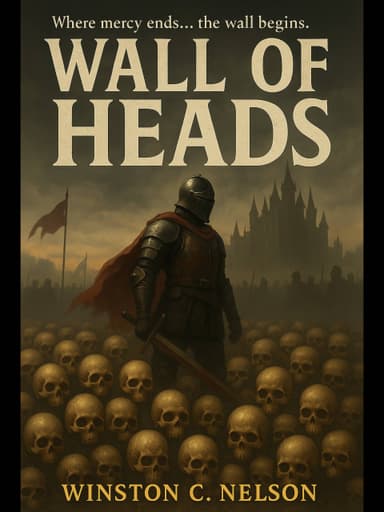
WALL OF HEADS
- Genere: Paranormal
- Autore: Winston C Nelson
- Capitoli: 17
- Stato: In corso
- Classificazione per età: 18+
- 👁 10
- ⭐ 5.0
- 💬 0
Sinossi
Following the events that led to him losing his parents and his childhood, Nathan must rise against all odds to defeat the king who stole everything from him, while trying to uncover the secrets hidden in the pages of the scrolls which describes his fate as the bleeding king who must emancipate the heads on all the walls.
Chapter 1: The four Kingdoms
There were four kingdoms set on different sides of the wind—one at the South, another at the West, the third at the North, and the last at the East. Over the kingdom in the South ruled King Darius; in the West, King Matthias; in the North, King Theodore; and in the East, King Levi.
In the middle of these kingdoms was a place where travelers and those who had no settlement in any of the kingdoms dwelt. This place was called the Midlands, and it had no king.
More often than not, peace fell asleep, and as a result, war came—and blood was spilled. In these wars, which were fought by two kingdoms at a time, warriors kept a record of how many men they had slain. At the end of each war, the victorious warriors marked the number of enemies each of them had slain, then took their heads back to their kingdom, leaving the headless bodies to rot on the battlefields.
The warrior with the highest count of heads was awarded by the king of his kingdom and allowed to take any maiden he pleased—except for the royals and women who had borne children. The heads from the battlefields were then used to build walls around the kingdom. Thus, the greater the walls of a kingdom, the more victorious that kingdom was in battle, and the more respected and feared its king, knights, and warriors became.
Each kingdom had its most powerful warrior, known as a Wingman, and these Wingmen were named according to the direction of their kingdom. These four Wingmen were each given one of four legendary weapons, forged by the greatest wizard that ever lived:
The Sword of the South: it endowed its user with unmatched willpower in battle and inhuman stamina.
The Bow of the North: it gave its user the accuracy to shoot arrows from an extraordinary distance.
The Axe of the East: it gifted its user with unbelievable strength and endurance.
The Spear of the West: it granted improved reflexes, precise attacks, and godlike speed.
These weapons were passed down through generations, from one Wingman to the next.
The Wingmen were respected by men, admired by women, and feared by children. A kingdom at war without its Wingman was as good as defeated.
The Southern Kingdom had its Wingman. He was skilled, swift, and a cunning b*st*rd. His name was Beth, and he was seen as the strongest Wingman of them all. Stories told that after every Southern battle, while others counted tens of heads, Beth counted hundreds—and trucks were used to bring them back to the Southern Kingdom.
The North had its Wingman. The East had theirs. The West had theirs. These three were also skilled—great masters of the sword.
Once every ten years, the four kingdoms gathered in an arena close to the Midlands to watch the two best Wingmen spar in a time-limited deathmatch.
All the kingdoms had walls, but the most formidable wall was that of the Southern Kingdom. It grew taller in times of war and even in times of peace. Despite being the most feared and respected, the South lacked in strategic areas: they ran short on livestock, with very few cattle, sheep, and goats. The government of the South was questionable, but the people never dared to question the king’s rule or speak ill of the royals. They feared that if they did, they’d end up watching over the kingdom—from the wall.
In a small village far north of the Southern Kingdom lived a boy who never believed in the Southern government—and who was bold enough to confront the king of the South, at least in his imagination.
His name was Nathan. He was the son of a local fruit vendor known as Earl. Nathan was always accompanied by a boy, Ethan, and a girl, Agatha.
These three were only children to their parents, and because of that, they saw each other as siblings. Nathan and Ethan shared much in common, but the most iconic of all was the dream they both held—to become the strongest warriors in the kingdom, and maybe one day, the South Wingman.
At dawn, they trained at the grounds with hundreds of other children who dreamed of becoming knights. Among them was the prince of the South, Prince Jephthah. The young prince claimed to be eager to learn and become strong—but his true motives were obvious. He looked down on everyone, and he was well known for his pride and arrogance.
Hacking and slashing with wooden swords, Nathan and Ethan exhausted themselves each morning in the training ground. Afterward, they spent their days playing, trying to develop a unique fighting style while dancing to the music of a blind woman.
ANATA
The blind woman, Anata, had been born without sight. Her parents were devastated. Her mother wept; her father blamed the mother for giving birth to a blind child. Their marriage ended. Her heartbroken mother cursed the child: “You shall never enjoy life, and your days shall be as short as my marriage.”
Then, she took the baby to a small stream in the South and abandoned her.
She was only a few months old—left without love, food, or water. She cried until her strength gave out. She was too weak to scream, so she sobbed quietly.
One day, a man named Oliver came to the stream. He often came there with his stringed instrument to enjoy nature and sing.
That evening was calm. He began to play and sing, but as he stood to leave, he heard a baby laughing.
Startled, he followed the sound and found the abandoned baby. At first, he considered walking away, but his heart wouldn’t let him. When he touched her, she cried loudly. He tried to calm her with funny faces—nothing worked. He rocked her gently—still nothing. Finally, he sang—and the baby stopped crying.
He sang for an hour. The baby laughed and tried to clap her tiny hands.
Oliver, a descendant of musicians, had no wife or family. Both his parents had “watched the kingdom from the wall.” He raised the child as his own and gave her everything in music. Because of her gift, he named her Anata, meaning “born to sing.”
She grew up to be the best singer in the South, and Oliver was proud—but he didn’t live long enough to enjoy her songs.
Anata was full of love. Though mocked and treated cruelly growing up, she never stopped singing in the village square each evening after the children’s training. She rejected the king’s invitations to sing in the palace—a dangerous choice for someone blind.
Nathan and Ethan always stopped to dance to her songs. Though blind, she always knew when they arrived—she had memorized their voices.
Agatha, however, had no interest in music or weapons. Her heart leaned toward something more spiritual: she dreamed of becoming a great witch doctor.
“Oh, tell us our future, Lady Agatha, great witch doctor of the South,” Nathan and Ethan said, falling before her in jest. She had drawn chalk lines on her face and wore feathers on her ears.
“One of you will become the South Wingman,” Agatha replied.
“Oh, come on—we all know it’s going to be me,” Nathan said.
“No! It’s me,” Ethan protested.
“You’ll have to spar for that,” Agatha said.
“No, I’ll never raise a weapon against Ethan,” said Nathan.
“Neither will I,” said Ethan.
“Then listen closely,” said Agatha, half-joking. “I hear swords clashing in the future—both of you, sparring before kings.”
They laughed and played on.
The next morning, the stench of rotting heads from the walls filled the air. Nathan had finished his chores. His father was at the castle selling fruits; his mother had gone to the fields to plant barley.
Now it was time to train. But first, he had to get Ethan.
At the training ground, Ethan excitedly declared, “Nathan! I’ve created a unique fighting style. I call it The Dancing Warrior.”
“That’s great. Can you teach me?” Nathan asked.
“Of course! First, raise your sword opposite mine. Then make a fake defense. After that, strike toward my core. If we both do it right, our sword tips will meet in the center.”
They practiced until the warriors arrived.
“Fight like warriors! Not like pregnant women!” one of the trainers yelled.
“You!” Prince Jephthah pointed at a warrior. “Find me someone to spar with. I’m tired of this boring training—I need real action.”
“Yes, my lord,” the warrior replied, choosing a weak-looking boy.
It wasn’t much of a fight. The prince defeated him in seconds, then spat on him.
“You’re nothing! Less than a mad dog! Bow before your god so that mercy may come upon you,” the prince roared.
The boy remained silent.
Angry, the prince grabbed a warrior’s sword and aimed to kill—but someone from the crowd struck him in the face.
The prince fell, bleeding.
“You are no god,” Nathan said, standing over him. “You're just lucky to be born royal. His life is worth more than all the dogs in your father's castle. And to me—his life is worth more than yours.”
“Nathan! Watch out!” Ethan warned.
Nathan didn’t run. He charged at the guards with his wooden sword.
He was beaten, bloodied, and humiliated.
“Wake him up! Is he dead?”
Voices echoed. Nathan wasn’t fully conscious.
A bucket of water hit him.
He snapped back to life. His hands were tied. He was in the king’s court.
“You’re finally awake,” said the king. “My son tells me you struck him. His face is now bent toward the kingdom I hate most.”
The king sipped wine. “Tell me, what gave you the courage?”
“He had it coming,” Nathan mumbled.
“I’m sorry—what was that?” the king asked.
“He tried to play god,” Nathan said clearly.
“You have a big mouth for a boy. You’ll grow into a great nuisance.”
The king drew his sword and approached. Nathan’s heart pounded. His eyes filled with tears.
The prince smirked.
“You could live—if you apologize to the prince and call him your god.”
Nathan stayed silent.
“A hardened boy, I see. Killing you here would stain my palace floor. Tomorrow, by noon, you will die in the Hall, before everyone.”
“To the dungeon! Whip him all the way!” the king barked.
When they were alone, the king said to Jephthah:
“You carry my blood. Everyone else is beneath us. Remember that. Never be soft. These lands are ours to conquer.”
Chapter 2: Dungeon Doctor
The sound of flesh being torn by whips, blood dripping on the floor, and tears running down Nathan’s cheeks filled the narrow path leading to the dungeon. Guards screamed, "Keep moving!"—their voices sharp and merciless.
Nathan was barely conscious, his legs weak and trembling. One of the guards, a man with a scar across his face, shoved him hard. Nathan lost balance, tumbling down the sloped path until he landed at the dungeon entrance.
"At least that saved time," the scarred guard muttered as they locked the gate behind him and marched back to the castle.
Lying on the cold, blood-stained floor of the dark dungeon, Nathan was on the brink of death, barely drawing breath. Then, from the shadows, a voice broke the silence.
"Another soul has come to rot and die," the voice said.
"Who are you?" Nathan asked weakly.
"I am the last person you'll meet before you die."
Nathan tried to speak again, but he was too far gone. The old man who had spoken



Usa AlphaNovel per leggere romanzi online quando vuoi e dove vuoi
Entra in un mondo dove potrai leggere tante storie e trovare i migliori romanzi d’amore e libri romantici con lupi mannari alfa che meritano la tua attenzione.


 Scansiona il codice QR e vai al download dell'app