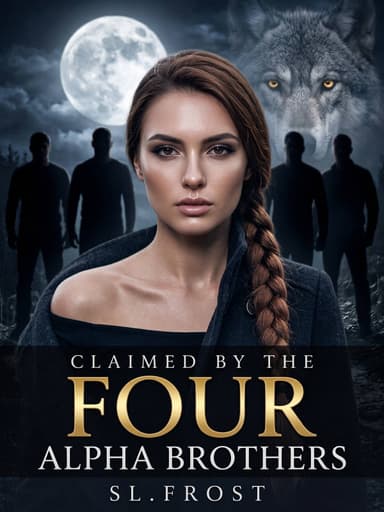
Claimed by the Four Alpha Brothers
- 👁 55
- ⭐ 7.0
- 💬 1
Résumé
One mate is a blessing. Two is a scandal. Four is a war. Wren has been the Duskmoor pack's unwanted charity case since the night rogues took her family — tolerated, unranked, and planning her quiet escape the day she turns twenty. She has exactly one plan: cross the border, disappear into the human city, and never again bow to wolves who let her sleep in the boathouse. Then the four Ashe brothers come home. Rulers of the strongest pack on the continent. Four Alphas who share one throne, one legend — a war hero, a cold strategist, a wild-tempered enforcer, a golden-tongued diplomat — and, as of the moment Wren collides with them on a smugglers' bridge in the rain, one impossible problem: the mate bond hits all four of them at once. For the same runaway nobody with mud on her boots and a knife in her sleeve. The Moon hasn't marked a four-fold Luna in a thousand years. The elders call it an abomination. The other packs call it an opportunity — because a shared Luna is a shared weakness, and everyone wants to know what happens to four unbeatable brothers if you take their one heart off the board. Wren doesn't want a throne. She wanted a bus ticket. But nobody ever let her keep anything she loved, and these four infuriating, devoted, terrifying men keep looking at her like she's the whole sky — so this time, Wren is going to learn to fight for what's hers. All four of them.
Chapter 1: Given Away at Moonrise
Six hours before my twentieth birthday, Alpha Odell Strand gave me to his son like a coat he'd finished wearing, and four hundred wolves laughed.
He did it on the shore, because the whole of Duskmoor was already there. The equinox run was due at moonrise, and on run nights the pack gathered at the lake's edge in its oldest clothes, ready to drop them in the reeds and go. The March wind came off the water hard enough to sting. Somebody had lit the iron braziers along the jetty, and the firelight made everyone look kinder than they were.
I was at the back, where I always was, holding a crate of bread rolls for afterward. A run makes wolves hungry, and somebody has to carry the bread.
"Before we go," Odell said, and the shore went quiet for him.
He was sixty-one that spring and still broad through the shoulders, with a voice he had been using on crowds for thirty years. He didn't need to shout. He just waited until the last pup stopped wriggling.
"Duskmoor keeps its law," he said. "Our law says a ward who reaches twenty without rank does not drift. She is bound to a household, for her keep and her good, for life."
Heads turned. Not toward him. Toward me, at the back, with my bread.
I counted the ways off the shore before I could stop myself. The jetty, which ended in water. The boathouse path, which ran straight past half the pack. The reeds, which were deep and cold and full of people about to undress. Three ways out, and not one of them any use.
"Wren Marsh turns twenty at midnight," Odell said. "So at dawn, under the old words, I bind her to my son's household. Lyle will see she's kept."
"Eleven years of bread," Odell went on. "Eleven years of a dry roof. It's time that debt was kept in a proper house."
Lyle stepped up beside his father, grinning. He was twenty-three and handsome in the careless way of a boy nobody important had ever told no.
"Come on, then, Wren," he called. "Show them how you say thank you."
The laugh started near the braziers and ran down the shore like a dropped plate rolling.
I knew what he meant. Everybody did. For eleven years, on every feast day, the charity case gave the charity bow. Knees, hands, forehead to the ground, in front of whoever had fed her.
"I'm holding the bread," I said.
"So put it down."
I put it down. Then I walked through four hundred wolves, who stepped aside exactly far enough to let me pass and not one inch further. At the waterline the shore turned to mud, black and freezing, and I knelt in it.
Nobody tells you how loud a crowd is when it's waiting for you to do something. I could hear the braziers spit. I could hear a pup ask his mother why, and his mother hush him.
I put my hands flat. I put my forehead down until I felt the mud take it.
"Good girl," Lyle said, and they laughed again, louder, because he'd made it a joke.
I stood up. Mud ran down my face and into my collar, and I didn't wipe it off, because wiping it would have given them one more thing to watch.
"See you at dawn," I said to him.
He blinked. Then the laughter came back harder, as if I'd told the best joke of the night, and Odell raised his arm, and the moon cleared the hills on the far side of the lake.
The shift went through the crowd in ripples, clothes dropping, backs bending, the first howls going up from the young ones who could never wait. In a minute and a half the shore was empty except for the clothes and the braziers and me.
Nobody waited. Nobody ever had. The charity case didn't run with the pack. She folded its clothes.
I picked up the bread.
Then I went up to the kitchen door, because there was one person in Duskmoor who hadn't laughed, and I wanted to see her before I did the thing I had been planning for six years and had just been given six hours to do.
Marta was standing in the doorway with her arms crossed. She was seventy-three and four foot eleven and she had been running Duskmoor's kitchens since before Odell had his adult teeth. She took one look at my face.
"Inside," she said. "Now."
"I'm muddy."
"You're always muddy. Inside."
The kitchen was hot and smelled of yeast. Marta wet a cloth and scrubbed my forehead hard, the same way she'd done the year I was nine and didn't say a word to anyone for a month.
"He has never bound a ward in my lifetime," she said. "He's doing it to you because he can't stand to look at you."
"What does that mean?"
"It means go tonight." She let go of my chin. "Don't pretend you weren't going to. I've known about the bag under the boathouse floor since you were fourteen."
I opened my mouth and shut it again.
Six years I'd kept that bag. One coat, two shirts, a tin of money from selling eels at the human market in Kestle, and a bus timetable with the 7:40 to Calder circled so many times the paper had gone soft as cloth.
"Three hundred and forty dollars," I said. "It's enough for the ticket and a week."
"It's enough for the ticket." Marta turned to the dresser and opened the drawer where she kept the good knives. She took out something wrapped in a dishcloth and put it in my hands.
It was heavier than it looked. I unwrapped it.
A plain blade with a black handle, worn pale where a thumb had rested for years. Cut into the steel just above the grip was a mark I had never seen in my life: a bird with its wings half open, standing on a rock.
"Your father's," Marta said. "I took it out of the river farm the morning after. I've kept it for you."
My hands went cold. "You never said."
"You never asked, and you were nine." She closed my fingers round the handle. "It was never a kitchen knife, child. Go tonight."
"What's the bird?"
"That's a question for somebody else." She pushed a loaf inside my coat, still warm. "Not here. Not anybody here."
"Who else is there?"
"Out there," Marta said. "Everyone who isn't Duskmoor. Now listen. Downwind of the run, along the Sable, and don't you stop at the farm."
Up in the hills the first full howl of the run went up, and a hundred voices answered it, and the kitchen windows hummed in their frames.
"Go," Marta said. She kissed my forehead where the mud had been and shut the door on me before I could see her face.
The boathouse was dark, and I could have crossed it blind. The board by the third post lifted under my thumbnail. The bag was where it had always been.
I didn't look at the blanket, or the nail where my coat hung, or the wall. I had said goodbye to the wall a thousand times in my head. It didn't need me to do it again.
I left my mother's quilt folded on the cot. It was too big for the bag, and it was the only thing I owned that I couldn't stand to carry into a bus station.
The smuggler's path ran along the river Sable through the alders, out of Duskmoor ground and into the strip of no-pack land before the human town. I went downwind of the run the whole way, the knife in my sleeve and the loaf against my ribs, and the rain started an hour in, the cold March kind that finds the gaps in everything.
Nobody came after me. I kept expecting it. I kept turning round.
Once, at the bend below the weir, I heard paws on the far bank and went flat in the bracken with my face in the wet. A big grey shape went along the water, nose down, close enough that I could hear it breathing. One of the hunters, running wide of the pack. I didn't breathe until it was gone.
My wolf wanted out. She always did on run nights. She was small and the colour of river mud and she had never once run with anybody, and she pushed at the inside of my skin all the way down the river like a dog at a door.
"Not tonight," I told her. "Tonight we walk on two legs and leave nothing anybody can read."
The path went past the turning for the river farm. I didn't take it. I hadn't taken it in eleven years. There was nothing up there now but nettles and a chimney, and the root cellar where I had sat in the dark on the night I turned nine, listening.
It had been a run night then, too. Duskmoor had been up in the hills. My father had been standing at our door with this knife in his hand.
I walked faster.
Tallow Bridge was an old stone thing the smugglers had used when there were still smugglers, one lane wide, no rail on the downstream side. On the other end of it, Duskmoor's law stopped. I could see the far bank in the dark. I could almost taste it.
At the near end I stopped and put my palm on the stone. It was cold and slick and older than Duskmoor. A hundred steps and I'd be standing on ground no Alpha owned. Nobody could bind a girl on no-pack land. Nobody could make her bow.
Twenty minutes early, I said happy birthday to myself out loud, to see how it sounded. It sounded ridiculous. I said it again anyway, and started across.
I was halfway across when the headlights came over the north road.
There was nowhere to hide on a bridge one lane wide, so I didn't. I stood in the middle with the rain in my eyes and the knife out, and four black trucks came down the hill in a line and stopped in front of me, engines running, lights full in my face.
"Move," I said, to nobody, to the trucks, to the rain. "I'm going across."
All four driver's doors opened at once.
Four men got out into the rain. They were big, every one of them, and they moved the way Alphas move, as if the ground had been put there for them specifically. I couldn't see their faces past the headlights. I could see their eyes find the knife in my hand before they found me.
Then the biggest of them took one step forward and stopped as if he'd walked into a wall.
"Cass?" one of the others said. "Cass, what is—"
He didn't finish. I watched the same thing happen to all four of them, one after another down the line, like a match being passed from hand to hand in the dark.
Four pairs of eyes went wolf-bright in the rain. Ice, grey, gold and green.
And every one of them said the same word.
"Mate."
Chapter 2: Four Times Over
It hit me a second after it hit them.
I had heard about the mate bond the way every girl in a pack hears about it, from the older girls in the bathhouse, who made it sound like falling in love and being struck by lightning on the same afternoon. They got the lightning right. Nobody had warned me there could be four of it.
Heat went through me like fever, top to toe, and then again, and again, and again, from four directions. My knees went. The knife nearly went with them.
I didn't let it. I lifted it instead and put the point against the throat of the nearest man, which was the biggest one, the one they'd called Cass.
He didn't move. Not a twitch. Rain ran off his jaw and down the blade.
"Back up," I said. "All of you."
"She's got a knife on Cass," said the one at the end, and laughed out loud, delighted. He had wild fair hair plastered to his skull and eyes like a struck match. "Rhys, she's got a knife on Cass."
"I can see that, Dorian."
Ça va aussi te plaire









Utilise AlphaNovel pour lire des romans en ligne quand tu veux et où que tu sois
Plonge dans un univers où tu pourras découvrir des histoires et dénicher les meilleurs romans d'amour et les meilleurs livres de romance mettant en scène des loups-garous alpha qui méritent vraiment ton attention.


 Scanne le code QR pour accéder au téléchargement de l'application