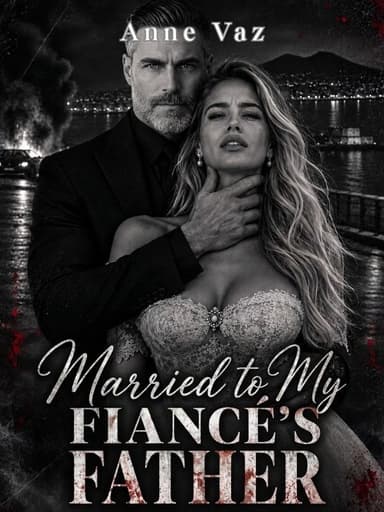
Married to My Fiancé's Father
- 👁 1
- ⭐ 5.0
- 💬 0
Sinopsis
Forced marriage • Substitute bride • Married to the groom’s father • Age gap • Possessive mafioso • Enemies to lovers • Virgin heroine • Revenge • Dark romance +18 I dressed as a bride for the son. I left the church married to the father. Paula Caccini was born to obey. At twenty-two, she was promised to Mario Moretti, heir to the family the Caccinis had hated for generations, to seal the peace between Naples’s two most dangerous clans. But on the wedding day, the groom never reaches the altar. His car is found in flames on a seaside road, and every eye turns to the bride’s family. To avoid a war, Paula’s father does the unthinkable and offers his daughter as payment to the most feared man in the mafia: Don Nicolo Moretti, a widower, ruthless, and father of the dead groom. Nicolo accepts. Not for peace, but for revenge. At the altar, he promises to turn every day of her life into hell. On the first night, he discovers that his enemy’s daughter is the only person capable of silencing the beast inside him. She swears she’s innocent. He swears he’ll uncover the truth, even if he has to set all of Naples on fire. He swore revenge. She was the price. Neither of them expected to fall in love.
The Groom Never Came
Paula Caccini
The groom was forty minutes late when I heard the word ambush.
It came from a group of Moretti men leaning against the vestibule door, spoken so low it could have been a prayer. Except men like those don’t pray. They count bullets, they count the dead, and they count who will pay for them.
“On the coastal road,” one of them said. “Near the lighthouse.”
“Betrayal,” another answered, and spat on the basilica’s marble floor. “It was the Caccinis.”
I felt the veil stick to the sweat on the back of my neck. My father stood beside me, his hand clamped around my elbow so hard I could no longer feel my fingers. He didn’t turn toward the men or ask anything. He kept staring at the church door as if he could break it down with his eyes.
“Father,” I called.
“Be quiet, Paula.”
I was. I’d spent my whole life being quiet.
I was quiet at twelve, when they buried my mother and I couldn’t cry in front of my father’s men. I was quiet three months ago, at the dinner where Don Caterino Caccini, my father, announced between the ragù and the wine that I would marry Mario Moretti, the heir to the family we’d hated since before I was born. I was quiet when Vincenzo, my brother, found me crying in the garden and said there was no choice, that we were pieces on a board and pieces don’t argue with the hand that moves them.
And I was quiet that morning, when my aunts stuffed me into an ivory lace dress that weighed like armor and pinned a veil that looked more like a shroud.
The only thing of mine on that dress was the silver brooch fastened at the neckline. A single pearl, my mother’s favorite jewel. The night of the announcement, alone in front of the mirror, I pressed the brooch so hard the pin pierced my hand, and a drop of blood stained the pearl. I never managed to clean it completely. I never tried very hard either.
The organ kept playing inside the church. Five hundred guests waited seated, the women fanning themselves and the men checking their watches. At the altar, the groom’s place remained empty.
I didn’t love Mario. I barely knew him. The few times we met, he looked at me the way one checks a horse before paying for it, and kissed my hand as if he were doing me a favor. But it was my destiny, and I had already learned to swallow destiny the way one swallows bitter medicine: all at once and without making a face.
I thought of the dinner the night before.
I remembered the hotel ballroom, the gardenias, and the two families sharing the same space like dogs locked in the same cage. The orchestra started a waltz, everyone turned toward the dance floor, and that was when I saw my father and Don Nicolo Moretti exchange a look over their glasses. My father tilted his head almost nothing, and Nicolo answered with a slow blink.
It wasn’t the look of two allies. It was the look of two men who shared the same secret and hated each other for it.
I asked Mario what lay behind that alliance. He smiled without showing his teeth and said that behind it was our future and that I shouldn’t ruin the night with foolish questions.
Now our future was late. And the men at the door were talking about an ambush.
The side door of the vestibule opened with a bang. Vincenzo entered, and it took me a second to recognize him. His tuxedo was askew, there was a black stain on his cheek, and the smell he brought on his clothes was of smoke, of burned rubber, and of something sweet and nauseating that I didn’t want to name.
“Father.”
My father finally released my arm.
“Speak.”
“Mario’s car was hit at the lighthouse curve.” Vincenzo swallowed hard and looked at me before continuing, as if apologizing. “It caught fire. He was inside. There wasn’t… there was almost nothing left.”
I didn’t fall. I still think about that, how I didn’t fall. The organ became a distant buzz, the golden walls of the vestibule seemed to recede, and I stayed on my feet, the bouquet of white roses in my hands, while the man I was going to marry turned to ash on a seaside road.
My father didn’t move. He nodded slowly, the way he nodded when one of his men brought him the price of olive oil.
“And Nicolo?”
“Inside. Nicolo’s men are going crazy, Father. They say it was us. Their hands are on their guns.”
My father adjusted the signet ring on his pinky finger. It was the gesture I’d seen since childhood, always before some decision that someone would pay for the rest of their life.
“Stay with her,” he ordered Vincenzo.
And he entered the church without looking at me.
Vincenzo gripped my shoulders. His fingers trembled.
“Paula. Look at me. Are you okay?”
“He wasn’t surprised,” I whispered.
“Who?”
“Our father. You told him Mario burned to death, and he asked for Nicolo. He wasn’t surprised, Vincenzo.”
I saw the understanding cross my brother’s face and, right behind it, the fear. Vincenzo knew as well as I did what that meant. If Mario Moretti had died on the way to his own wedding, and if his blood was on our family’s hands, Naples would burn before sunset. And the two of us were at the center of the fire, dressed for a party.
On the other side of the door, someone shouted. I heard glass breaking and a bench being dragged. The organ stopped in the middle of a chord, and the silence that followed was worse than any scream.
I counted the seconds. Vincenzo counted with me, without realizing, his lips moving. I reached three hundred and something when the door opened again.
My father entered first. His tuxedo was still impeccable, and on his face there was a calm that scared me more than fury. Behind him came Don Nicolo Moretti.
I had seen him before, at business lunches and dinners, always in a three-piece suit and with that cold elegance of someone who never needs to raise his voice. In Naples, they said Nicolo Moretti extracted information the way a dentist extracts a tooth, with sharp tools and no anesthesia, and that he only stopped when he got what he wanted. They also said he had never forgiven anyone. Twenty years earlier, Nicolo’s younger brother had been found dead at the port, and everyone knew, without anyone saying it out loud, whose order it had been.
My father’s.
That morning, he looked like a different man. His tie was loose and the gray hair at his temples was disheveled, as if he had run his hands through it many times. His blue eyes, so light they looked like glass, were red at the edges. And they were fixed on the back of my father’s neck with a hatred so pure that I felt that heat from the other side of the vestibule.
My father stopped in front of me.
“The wedding will continue.”
I thought I hadn’t heard right.
“Father, Mario is dead.”
“I know.” He didn’t blink. “The groom will no longer be Mario. It will be Don Nicolo.”
The air left my lungs. I looked at Nicolo expecting him to laugh, to shout, to pull a gun and end that madness. He did none of those things. He stayed still, fists clenched at his sides, and only then shifted his gaze from my father to me.
He was my fiancé’s father. He was the man who, until five minutes earlier, would have been my father-in-law.
“No,” it came out of me like a moan. “Father, please, you can’t…”
“I can and I will.” His voice echoed off the golden walls. “There are five hundred people in there waiting to see if our families are going to kill each other at the altar. The only way to avoid a war is to show that the alliance still stands. That the betrayal didn’t come from us.”
“And if it did?” I asked.
The entire vestibule seemed to shrink. Vincenzo squeezed my arm hard, a warning. Nicolo slowly turned his face toward my father, waiting for the answer with the same interest as me.
My father didn’t answer me. He answered him.
“It didn’t,” he said, looking into Nicolo’s eyes. “And you know that better than anyone.”
The two of them stared at each other for a moment that lasted too long, and I saw again what I had seen at the dinner the night before: the same secret passing from one to the other, heavy and dirty. Nicolo was the first to look away. My father leaned in until his face was a palm’s width from mine, and I smelled the cologne and tobacco that had accompanied my entire childhood.
“You are a Caccini, Paula. Your life belongs to this family. Mario is dead, and the blood debt must be paid. You are the compensation.”
Compensation.
I was the payment for a death that perhaps my own father had ordered. And the creditor was standing two meters from me, looking at me as if I were the only thing in that church he could break without starting a war.
Nicolo took a step forward. Vincenzo placed himself between us, a courageous and useless gesture, and Nicolo didn’t even look at him. He examined me slowly, from the hem of the dress to the veil, in no hurry at all. It wasn’t the look of a man at a woman. It was the look of a jailer at the prisoner he had just received.
When his eyes returned to my face, something changed in them for an instant. I don’t know if it was surprise or recognition. It passed too quickly, and then the ice returned.
“Yes,” he said, with the hoarse voice of someone who had shouted very little time before. “The wedding proceeds.”
Let Him Go
Nicolo Moretti
The priest was shaking so hard the prayer book knocked against his chest.
“Do you, Nicolo… take Paula to be your lawful wife?”
The entire church held its breath. I felt the stares on my back—my men’s, Caterino’s men’s, and their wives’, who hours later would be telling the story in every kitchen in Naples. Don Nicolo Moretti married his dead son’s bride. Don Nicolo Moretti accepted Caterino Caccini’s leftovers.
My son was burning on a seaside road, and I was standing at an altar.
Mario. The boy I taught to shoot at eleven, to negotiate at fifteen, and to make a man kneel without ever touching him. He had plenty of fury and no patience. The night before, he disobeyed me for the last time: he left the hotel for a bachelor party in a brothel on Caccini territory, after I had forbidden it in no uncertain terms. I knew why. It was because of that opera singer, the ragazza I’d ordered out of Naples months earlier. He wanted to f
También te gustará










Usa AlphaNovel para leer novelas en línea en cualquier momento y en cualquier lugar
Entra en un mundo donde podrás leer historias y descubrir las mejores novelas románticas y de hombres lobo alfa que merecen tu atención.


 Escanea el código QR y ve a la descarga de la aplicación