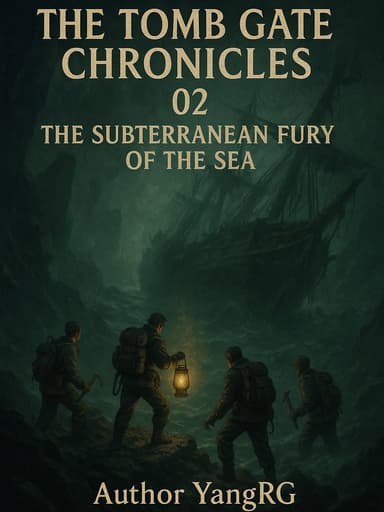
The Tomb Gate Chronicles 02: The Subterranean Fury of Sea
- Género: Paranormal
- Autor: YangRG
- Capítulos: 37
- Estado: Completada
- Clasificación por edades: 18+
- 👁 63
- ⭐ 7.5
- 💬 0
Sinopsis
When an exquisitely crafted bronze fish, its eyebrows shaped like serpents, emerges from the depths of an ancient mystery, it leads Wu Sansheng—affectionately known as Third Uncle—into a haunting journey beneath the sea. Once a legend in the tomb-raiding circles, Third Uncle finds himself drawn into a past he'd rather forget when memories of a tragic underwater excavation resurface with uncanny clarity. A decade ago, youthful bravado and a mysterious love led him to the Xisha Islands, where an underwater tomb claimed the lives of everyone except him, including his beloved Wenjin. Now, as history threatens to repeat itself, Third Uncle's nephew becomes embroiled in a web of enigmas, ancient artifacts, and supernatural encounters that defy explanation. He soon learns that the bronze fish holds the key to a greater puzzle—a puzzle that has drawn treasure hunters, archaeologists, and sinister forces alike into a desperate search beneath raging tides and sunken sands. As storms rise and tensions mount, a ghostly ship appears, heralding ominous events and stirring whispers of ancient curses. Strange phenomena haunt those who dare venture into these submerged chambers, and survival hinges on deciphering secrets buried centuries ago. Is it greed or destiny that draws them deeper into darkness, and can they escape the pull of the past, or are they doomed to vanish into legend like those before them? Blending pulse-pounding adventure with eerie suspense, "Raging Tides and Sunken Sands" immerses readers in a gripping tale where ancient tombs conceal both priceless treasures and chilling secrets. Dive into the depths, where history is lethal, every relic has its price, and some mysteries are better left buried beneath the waves.
Chapter 1
**Chapter 1: The Bronze Fish with Serpentine Eyebrows**
The box lid slowly opened on its own, revealing a tiny compartment no larger than a pinky finger. Inside lay a small bronze fish. I picked it up and examined it—the fish itself looked ordinary, but the craftsmanship was exquisite. What stood out were its eyebrows, intricately designed to resemble serpents, so lifelike they seemed almost real. I was baffled. What made this thing so valuable that it warranted such careful storage?
Just then, Third Uncle dragged in an oxy-fuel cutting tank and froze when he saw the open box. "It's open? How did you manage that?"
I explained the numbers to him, and his frown deepened. "This is getting more complicated. Seems those Americans aren’t just here for tomb raiding." He picked up the bronze fish, and his expression suddenly shifted. "Huh? Isn’t this the Serpent-Eyebrow Bronze Fish?"
Seeing that he recognized it, I pressed for answers. He reached into his inner pocket and pulled out an object, handing it to me. It was another finely crafted bronze fish, about the size of my pinky. This one also had sea serpents for eyebrows, its scales meticulously detailed. It was clearly from the same origin as the one in the box. The only difference was that the grooves between its scales were clogged with stubborn white, chalky residue. I immediately understood. "This is a sea relic?"
Third Uncle nodded. I was surprised. "Sea relics" referred to antiques salvaged from the ocean—usually blue-and-white porcelain. Hunting for treasures underwater was easier than on land since many artifacts lay exposed on the seabed. But due to marine microorganisms, items retrieved from the sea were often coated in a white, crusty grime that was nearly impossible to clean, significantly lowering their value.
Confused, I asked, "Did you go diving for sunken tombs?" I couldn’t recall Third Uncle ever being interested in low-value loot like this.
He nodded again. "Only once. And I regret it. If I’d resisted the temptation back then, I’d probably have a house full of kids by now."
I knew a little about that part of his past. Third Uncle had once been involved with a remarkable woman—a tomb raider herself. They’d met on a job. Her name was Wenjin, and though she seemed quiet and refined, she was a skilled practitioner of the northern school of tomb raiding. The two had been together for five years, a legendary duo in the underground world—she located the tombs, he explored them. Then, suddenly, she vanished. I’d always assumed she’d met her end in a tomb. After all, this wasn’t a trade suited for women. Our family had mourned her, though I’d been too young to understand. All I remembered was Third Uncle being utterly devastated for weeks.
Now, sensing he might finally share the story, I was burning with curiosity but tried not to seem nosy. "Did something happen during a sea tomb raid?"
Third Uncle sighed. "Back then, we were both young. She had a few classmates in archaeology, and they vaguely knew about my… profession. I didn’t hide it—we were all close. Later, when they organized a shipwreck excavation in the Xisha Islands, I tagged along. But I never expected…" He paused, as if reluctant to revisit the memory. "I never expected the thing lying at the bottom to be so massive."
This would’ve been over a decade ago. Third Uncle had no experience with underwater tombs, but love had clouded his judgment. Eager to impress Wenjin, he’d boasted about his skills and joined the expedition. They chartered a local fishing boat and sailed for two days until they reached the treacherous waters near Wan Reef, a notorious stretch of the ancient Maritime Silk Route littered with shipwrecks. When Third Uncle dove down, he was stunned—the seabed was carpeted with shattered blue-and-white porcelain, a sight both breathtaking and heartbreaking.
Wenjin explained that these were remnants spilled from sunken ships, scattered by the currents. In the past, fishermen would haul up four or five pieces in a single net, but they believed anything from the sea belonged to the Dragon King and usually threw them back.
The problem was, most were broken. Even intact pieces were usually encrusted with marine growth, making them nearly impossible to clean. While Wenjin’s classmates were thrilled by their archaeological value, Third Uncle only saw wasted treasure. He cursed, wishing he’d been born earlier—never mind that blue-and-white porcelain wasn’t even considered antiques back then.
For two or three days, they hauled up baskets of porcelain. Third Uncle, a connoisseur of ceramics, could lecture for hours about any piece he picked up. Soon, he became the team’s unofficial leader. His name was Wu Sansheng, and the younger crew members affectionately called him "Brother Sansheng," inflating his ego until he truly believed he was in charge.
Then, on the fourth day, disaster struck. One of the archaeologists took a rubber dinghy out and failed to return by dusk. The team panicked and set out to search, eventually finding the dinghy stranded on a reef two kilometers from Wan Reef—but its occupant was gone.
Third Uncle immediately realized the worst: the man must’ve gone diving and gotten into trouble. They geared up and searched underwater all night until they finally found his body, his foot trapped in coral, bloated from hours in the water. As they hauled him up, Third Uncle noticed his left hand was clenched tightly around something. Prying it open, they discovered the Serpent-Eyebrow Bronze Fish.
Though everyone mourned the loss, Third Uncle sensed something unusual. This man wouldn’t have risked a nighttime dive unless he’d spotted something valuable. He suspected the victim had seen something during the day’s search but kept it to himself, returning alone under cover of darkness. Of course, Third Uncle kept these thoughts to himself—what good would it do now? But the bronze fish in the dead man’s grip was a clue.
The next day, Third Uncle addressed the team: "Comrade So-and-so dedicated himself to archaeology, working tirelessly until tragedy struck. But the artifact he retrieved proves he discovered something significant. He gave his life for this Serpent-Eyebrow Bronze Fish. We must honor his sacrifice." His words rallied the team, and they returned to the site for a thorough underwater sweep. Soon, they found something.
Dozens of massive stone anchors—over forty of them—lay scattered across the seabed, all identical in size. The inscriptions on them had faded beyond recognition. Third Uncle theorized these anchors either came from forty identical ships or belonged to a single vessel. The answer was obvious: forty ships wouldn’t sink in the same spot. This could only mean one thing—an enormous ship lay beneath them, so massive it required forty anchors to stay moored.
Third Uncle, well-versed in history, formed a bold hypothesis. When he surfaced, he turned to Wenjin and said, "What’s down there… it’s not just a shipwreck. It’s an underwater tomb."
**Raging Tides and Sunken Sands**
**Chapter 2: The Double-Layered Tomb Wall**
Wenjin and Third Uncle came from completely different backgrounds. Third Uncle was a rough-and-tumble tomb raider—had he not been born into a family of grave robbers, he would’ve undoubtedly become a bandit. He approached everything with profit in mind, sizing people up based on what he could gain from them. Wenjin, on the other hand, was different. She had studied abroad, her thinking was more progressive, and her interest in tomb raiding was driven primarily by curiosity. She also conducted research while exploring, so when Third Uncle made his suggestion, her first thought was the archaeological value of the ancient tomb. She immediately wanted to share this idea with her classmates.
Shipwreck burials in underwater tombs were extremely rare. The only known figure in legends said to have been buried this way was the son of Shen Wansan. So Wenjin’s intentions were undoubtedly noble. However, Third Uncle was a bit hesitant—the thought of handing over any recovered artifacts to the state made him uneasy. But Wenjin was resourceful. With a smile and a kiss, she transformed Third Uncle from an outlaw into a volunteer archaeological researcher for the Republic.
That night, Third Uncle lay awake, deep in thought. He had never raided an underwater tomb before, and now that he had boasted in front of the others, he had no choice but to perform the next day. He considered the challenges—digging underwater was nothing like on land. For one, it was impossible to drive a shovel into the seabed with any real force. And even if they managed to excavate, the sediment underwater was completely different from soil on land, rendering his usual methods useless. He recalled the notes in my grandfather’s journal. My grandfather had indeed explored a few underwater tombs, but there were no special techniques mentioned—it mostly came down to reading the terrain.
A shipwreck burial involved constructing a tomb inside a vessel, then sinking it into a trench or depression in the seabed before sealing it with sediment—essentially the same as a land burial, just relocated underwater. Third Uncle deduced that the area they were in must have originally been a small underwater valley that had later been filled in. When the ship was sunk, multiple anchors would have been used to secure it in place. Therefore, the center of those anchor points—or somewhere slightly off-center—would mark the burial site.
The more he thought about it, the more convinced he became. By the next morning, his confidence had fully returned. He led the team back into the water, tied ropes around the anchor stones to connect them, and marked a central point. He then took samples from several spots within the marked area. Sure enough, slightly east of the center, they discovered wood beneath the seabed.
Chapter 2
Using traditional surveying methods, they soon mapped out the outline of a massive underground palace. Third Uncle was stunned. *Who the hell is buried here? This is no ordinary tomb.* That night, everyone was too excited to sleep. They gathered around a pot of fish-head stew and seafood, discussing how to break in. Third Uncle explained the structure of a shipwreck burial—tombs feared water the most. If the burial chamber below had already flooded, they could simply drill a hole and enter. With their diving suits, that wouldn’t be a problem. But if the chamber was still sealed, things would get tricky. Breaking in could cause a catastrophic flood. Judging by the wood fragments they had retrieved, there was likely still air inside. The tomb was enormous, possibly with capillary-like structures that trapped pockets of air in certain chambers.
Third Uncle’s theories, drawn from years of tomb-raiding experience, left the academics in awe. Eventually, he focused the discussion on











Usa AlphaNovel para leer novelas en línea en cualquier momento y en cualquier lugar
Entra en un mundo donde podrás leer historias y descubrir las mejores novelas románticas y de hombres lobo alfa que merecen tu atención.


 Escanea el código QR y ve a la descarga de la aplicación